A procurement and quality assurance guide by ArmorGuard for defense agencies, tactical gear brands, and distributors seeking certified OEM partners across Asia.
Why OEM Partner Quality Defines Success
In the ballistic protection industry, the quality of your OEM factory determines the reliability, certification, and market credibility of your brand. Choosing the wrong partner can result in failed tests, shipment delays, or even product recalls. With increasing international tender requirements, a qualified OEM partner must not only meet ballistic protection manufacturing standards but also maintain traceable testing and compliance documentation throughout production.
Key Criteria for Evaluating a Body Armor OEM Factory
When evaluating an OEM manufacturer for ballistic armor production, procurement officers should assess not only compliance certificates but also the factory’s engineering capabilities, quality systems, and supply chain transparency.
Below are the essential criteria recommended for inclusion in your factory evaluation checklist:
⚙️1. Certification & Testing
- Verify compliance with NIJ 0101.06 / 0101.07, STANAG 2920, and ISO 9001:2015 / ISO 14001 quality systems.
- Ensure the manufacturer can arrange on-demand ballistic testing through accredited laboratories (e.g., HP White, OBL, TÜV, Aitex).
- Confirm that pre-NIJ testing and BFD/V50 simulation equipment are available in-house for batch-level verification.
⚙️ 2. Production Capacity & Process Control
- Evaluate monthly output capacity, production line automation, and QC staffing ratio.
- Assess whether key processes—such as cutting, lamination, stitching, and carrier assembly—are performed in-house or outsourced.
- Review real-time QC traceability systems for batch tracking and defect reporting.
ArmorGuard Benchmark Example:
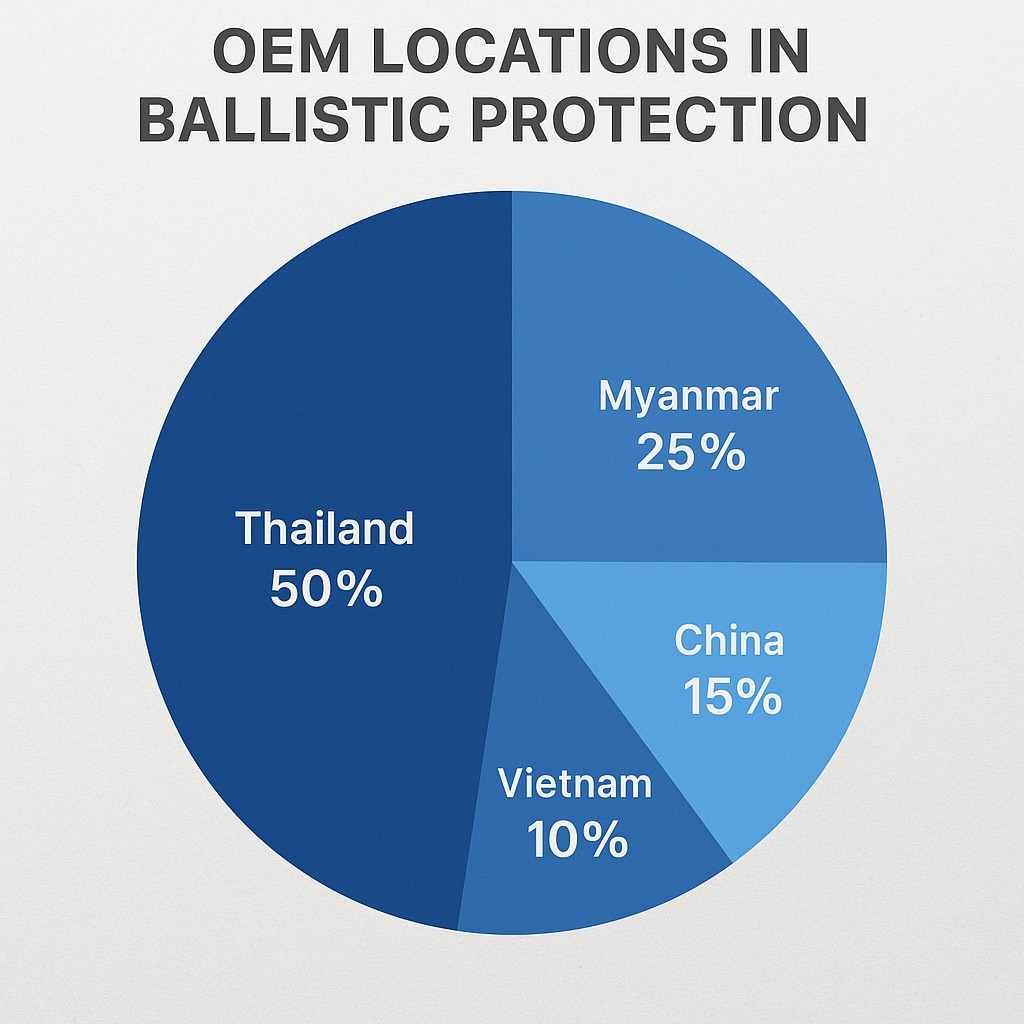
- Thailand factory: 25,000–30,000 tactical vests/month (automated cutting, CNC lamination lines)
- Myanmar factory: 15,000 vests/month (manual & semi-auto hybrid production)
- Combined output: up to 45,000–50,000 units/month with scalable OEM/ODM flexibility
⚙️3. Material Control & Supply Chain Transparency
- Confirm that the factory maintains traceable Aramid and UHMWPE input lots, including supplier certification (e.g., DSM, Teijin, Toyobo).
- Check for proper storage, humidity, and temperature control in ballistic material warehouses.
- Verify that material inspection reports (tensile strength, areal density, etc.) are logged per production batch.

What Certifications to Look For
Certifications form the foundation of credibility in the ballistic protection supply chain. Verified OEM factories maintain traceable certification systems and cooperate with accredited laboratories to ensure consistent product performance and international compliance.
Below are the key standards and documentation that procurement teams should verify when assessing a ballistic armor manufacturer:
- NIJ 0101.06 / 0101.07 Ballistic Compliance — Defines global benchmark levels for handgun and rifle threat protection.
- STANAG 2920 Fragmentation & V50 Verification — Measures the impact velocity at which 50% of projectiles penetrate, required for NATO-aligned tenders.
- ISO 9001:2015 Quality Management System — Ensures standardized production control, documentation, and continuous improvement.
- Export License — Required for regulated defense or dual-use items; issued by the Ministry of Commerce or Defense in respective countries.
- End-User Certificate (EUC) — Verifies authorized export destinations and final product users.
See NIJ vs STANAG Comparison for details on certification equivalency and testing scope.
Factory Visit and Quality Control Checklist
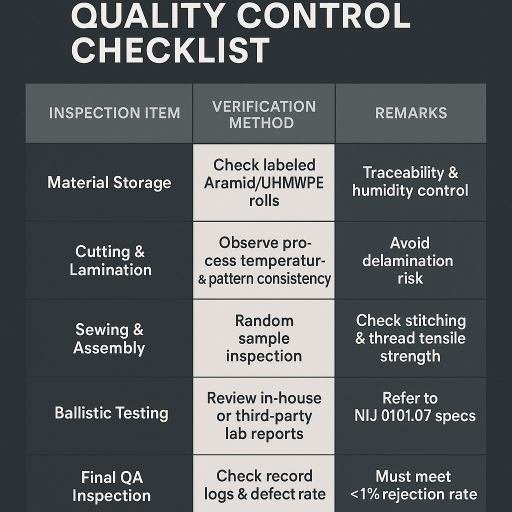
Conducting a physical or virtual audit of the OEM factory is essential. Below is a structured checklist that can be adapted for internal or third-party evaluations:
| Inspection Item | Verification Method | Remarks |
| Material Storage | Check labeled Aramid/UHMWPE rolls | Traceability & humidity control |
| Cutting & Lamination | Observe process temperature & pattern consistency | Avoid delamination risk |
| Sewing & Assembly | Random sample inspection | Check stitching & thread tensile strength |
| Ballistic Testing | Review in-house or third-party lab reports | Refer to NIJ 0101.07 specs |
| Final QA Inspection | Check record logs & defect rate | Must meet <1% rejection rate |
Red Flags: How to Avoid Unqualified OEMs
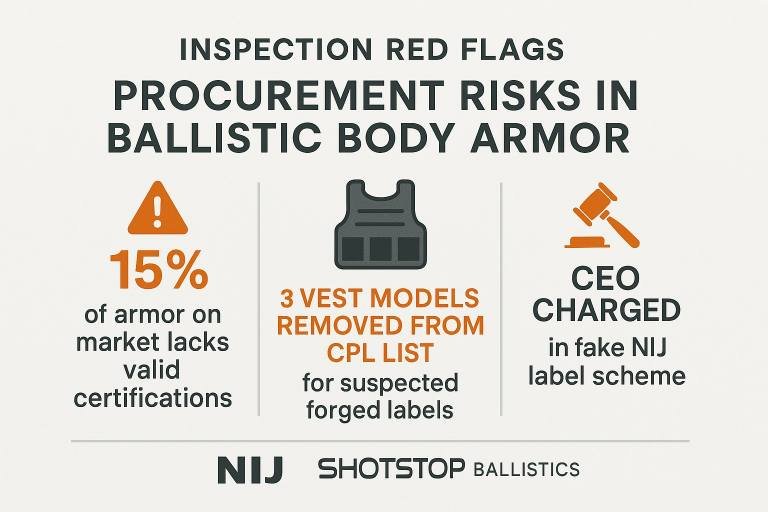
Not every factory advertising NIJ compliance is legitimate. Unqualified OEMs can damage procurement integrity. Watch for these warning signs:
❌ No valid NIJ or ISO certificates, or unverifiable report numbers.
❌ Refusal to provide ballistic test documentation or sample reports.
❌ Subcontracting production without client approval.
❌ Unrealistic lead times or abnormally low pricing.
❌ Poor communication or missing QA/QC documentation — see Evaluate supplier for tenders.
Why Choose ArmorGuard as Your OEM Partner
ArmorGuard operates dedicated ballistic OEM facilities in Thailand and Myanmar, strategically located to serve defense and tactical clients across Asia, the Middle East, and Eastern Europe.
Our production model combines precision manufacturing with on-demand ballistic testing, ensuring every project achieves traceable, contract-ready compliance.