An updated 2025 guide by ArmorGuard outlining the most effective ballistic protection systems for police and military units. This comprehensive overview helps procurement teams select the optimal armor type based on mission environment, threat level, and comfort requirements.
Why Selecting the Right Protection Matters
According to Fortune Business Insights (2024), the global body armor market was valued at USD 6.72 billion in 2024 and is expected to reach USD 7.60 billion by 2025, reflecting the growing demand for lightweight and modular protection systems among military and police forces. Meanwhile, Grand View Research (2024) estimates that the broader military personal protective equipment market—which includes ballistic vests, helmets, and tactical carriers—will exceed USD 19 billion by 2025, highlighting the increasing investment by defense agencies in next-generation protective solutions.
When these segments are combined, global spending on ballistic and protective equipment for military and law-enforcement applications is projected to reach approximately USD 8 – 9 billion by 2025, representing steady year-over-year growth of around 5 %.
(Sources: Fortune Business Insights – Body Armor Market Report 2024; Grand View Research – Military PPE Market 2024; Polaris Market Research – Ballistic Protective Equipment Report 2024.)
This steady increase reflects a global trend toward mission-specific armor systems—solutions that prioritize operator mobility, heat management, and traceability of certification. As procurement standards tighten under NIJ and STANAG frameworks, agencies are moving away from one-size-fits-all armor toward data-driven, threat-matched configurations.
ArmorGuard’s integrated ballistic protection manufacturing framework supports this evolution by combining certified materials, ergonomic design, and traceable testing documentation. Whether for government tenders or tactical OEM partnerships, ArmorGuard ensures that every solution aligns precisely with the operational and environmental demands of modern defense agencies.
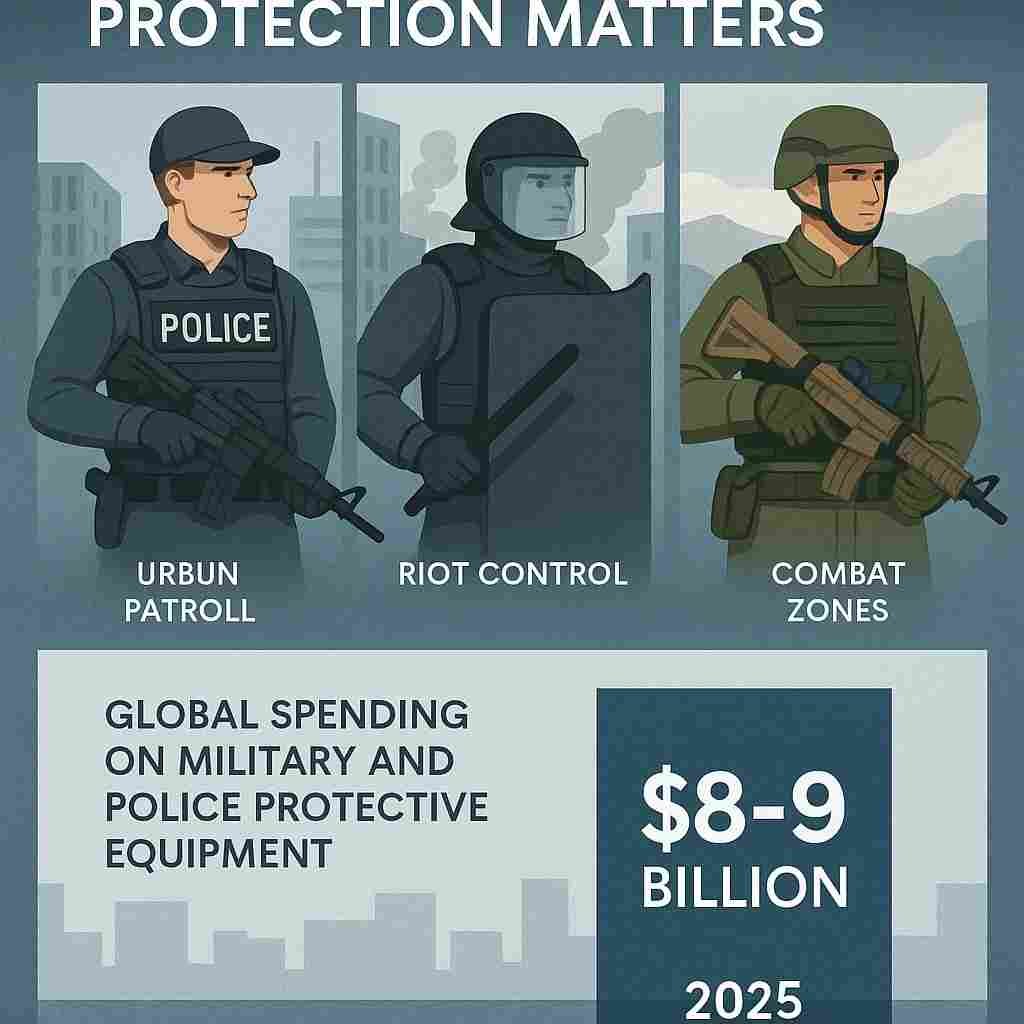
Top Ballistic Protection Solutions for Police and Military (2025)
1️⃣ NIJ IIIA Soft Armor Vest (Police Standard)
Designed for law enforcement and security operations that require flexibility, concealability, and lightweight protection.
Constructed from certified Aramid or UHMWPE fabrics, these vests offer reliable handgun resistance under NIJ IIIA standards.
Ideal for patrol officers, security personnel, and VIP protection teams operating in urban or low-threat environments.
2️⃣ NIJ III/IV Hard Plate System (Military Grade)
Provides rifle-rated protection for military, border security, and tactical response units.
Utilizing ceramic–UHMWPE composite plates, this system balances multi-hit resistance with mission mobility.
Engineered for front-line soldiers and special operations requiring STANAG 2920–verified ballistic performance.
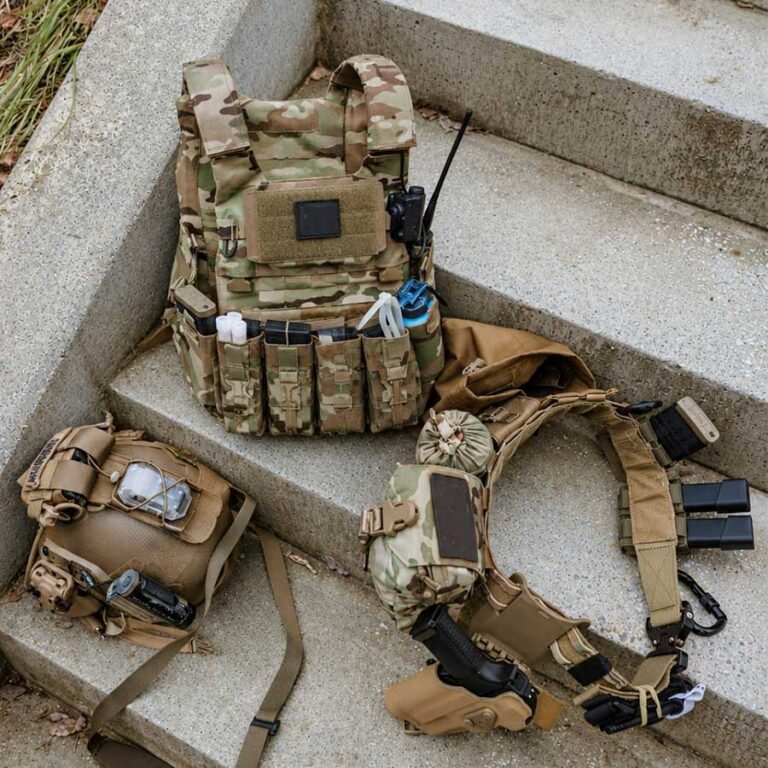
3️⃣ Hybrid Tactical Carrier System
A modular design integrating both vest and plate carrier configurations.
Allows operators to adjust protection levels via interchangeable panels dynamically.
Widely adopted in multi-threat missions where both handgun and rifle protection are required.
4️⃣ Riot Control Ballistic Ensemble
Developed for police and paramilitary forces handling civil unrest or riot control operations.
Incorporates impact-resistant limb guards, anti-stab inserts, and energy-diffusing padding for maximum operator safety.
5️⃣ Lightweight Covert Armor (Undercover Operations)
Ultra-thin ballistic panels engineered for intelligence and undercover missions.
Prioritizes comfort, breathability, and concealment under civilian clothing while maintaining certified ballistic protection.
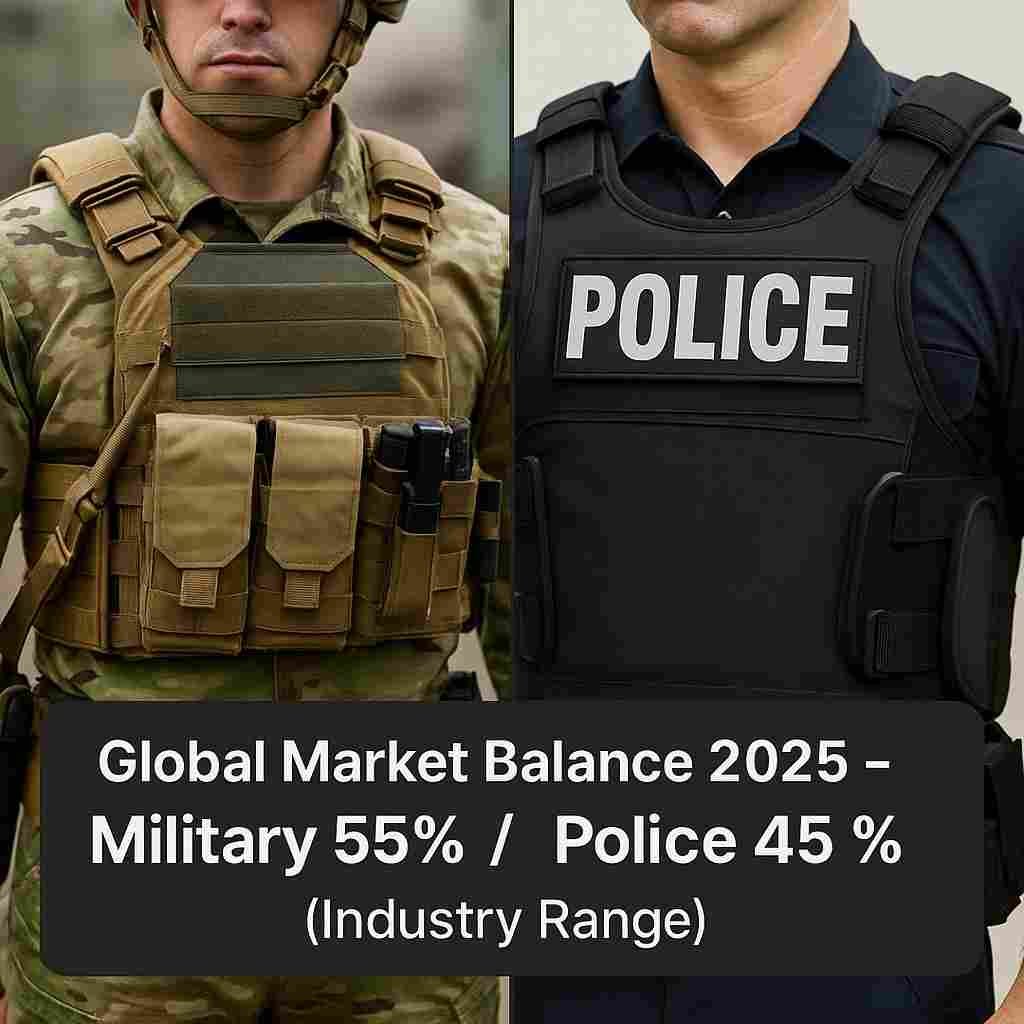
⚙️ Market Insight: ArmorGuard Product Focus (2025 Projection)
According to industry trends from leading tactical equipment analysts (Fortune Business Insights, Grand View Research, and internal market benchmarking),
the global ballistic protection demand is expected to be roughly balanced between military and police sectors, with defense-related programs accounting for 50–60% of worldwide spending and law-enforcement use representing 40–50%.
Within this industry context, ArmorGuard’s 2025–2026 product roadmap aligns with the same market distribution, emphasizing both military-grade OEM production and police/paramilitary ODM development in equal measure—ensuring scalable supply for tenders, agencies, and tactical brands worldwide.
(Sources: Fortune Business Insights, “Body Armor Market Report 2024”; Grand View Research, “Ballistic Protective Equipment 2024”; ArmorGuard internal strategy alignment, 2025 projection.)
Comparative Overview: NIJ Levels and Use Cases
The following table summarizes the NIJ ballistic protection levels, corresponding threat types, and ArmorGuard’s recommended configurations for each mission profile.
It provides a quick technical reference for procurement officers evaluating armor requirements for police, military, and tactical units.
| NIJ Level | Threat Type | Typical Use | Recommended by ArmorGuard |
| IIA / II | Handguns (9mm, .357 Magnum) | Police patrols, VIP protection, security operations | Lightweight soft vest (Aramid / UHMWPE) |
| IIIA | High-velocity handguns (.44 Magnum, submachine gun rounds) | SWAT, riot control, special police | Hybrid soft armor (Aramid + UHMWPE) |
| III | Rifles (7.62×51mm NATO, .308 Win) | Military field missions, border security | Hard plates (Ceramic + UHMWPE) |
| IV | Armor-piercing rifle rounds (7.62×63mm AP) | Frontline combat, counter-terrorism | Ceramic composite + hybrid multilayer plate |
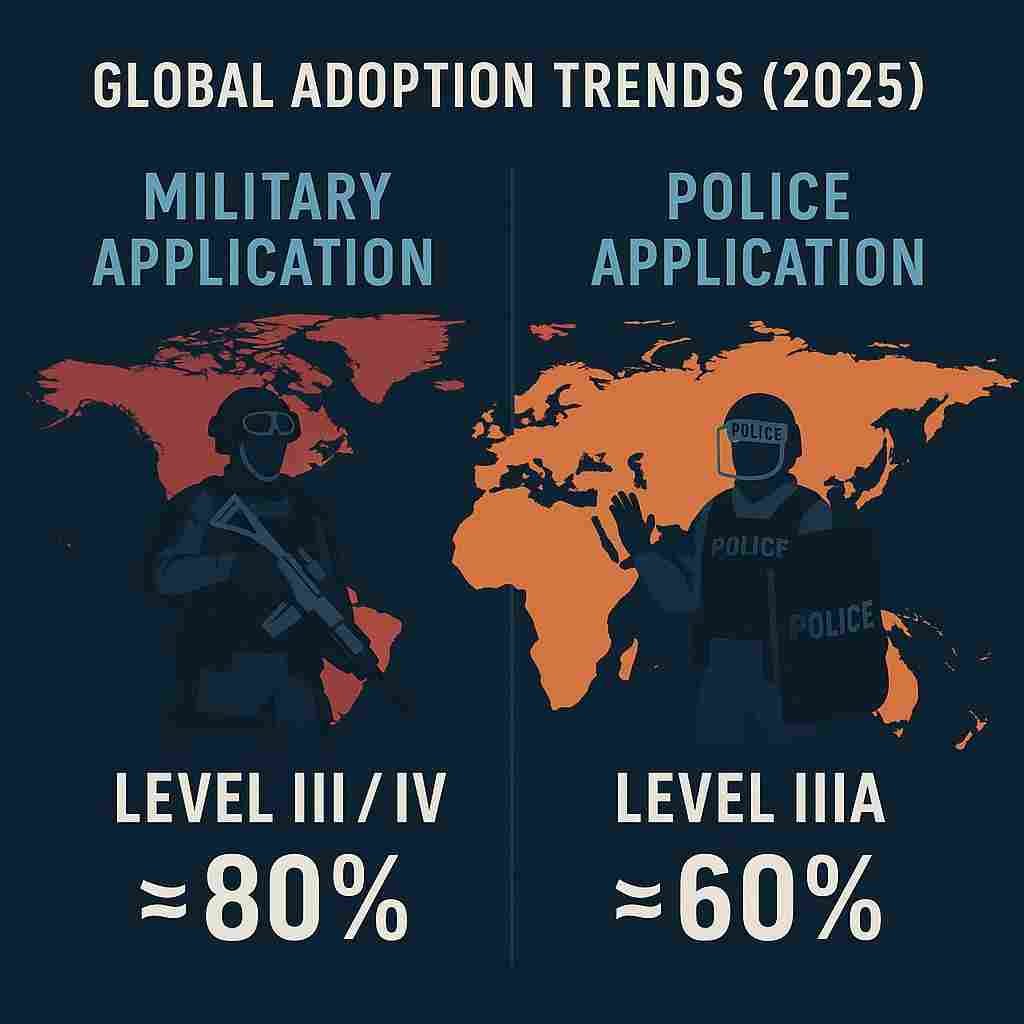
⚙️ Market Insight: Global Adoption Trends (2025 Projection)
According to aggregated data from Fortune Business Insights, Grand View Research, and Polaris Market Research (2024–2025):
Approximately 80% of global military users rely on NIJ Level III and IV ballistic systems or their STANAG 4569 equivalents, reflecting the shift toward rifle and AP protection.
Meanwhile, around 60% of police and law-enforcement agencies worldwide primarily use NIJ Level IIIA soft armor, optimized for handgun threats and mobility in urban environments.
The remaining 40% of police deployments, especially in high-threat regions (the Middle East, Latin America, and Southeast Asia), are gradually transitioning to hybrid IIIA–III systems for improved rifle protection without added weight.
(Sources: Fortune Business Insights – “Body Armor Market 2024”; Grand View Research – “Ballistic Protective Equipment 2024”; Polaris Market Research – “Tactical & Law Enforcement Armor Report 2024”; ArmorGuard internal benchmarking, 2025 projection.)
Material Innovations Behind These Solutions
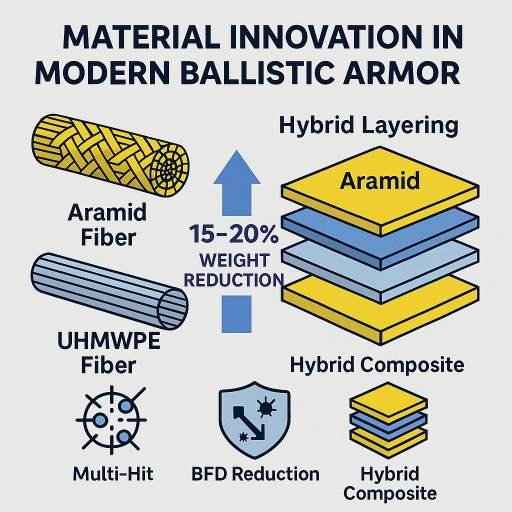
Each modern ballistic protection system is built on continuous advancements in material science. Aramid, UHMWPE, and hybrid composite configurations determine the armor’s balance between protection, mobility, and weight efficiency. These materials are engineered to minimize back-face deformation (BFD), enhance multi-hit durability, and improve thermal stability under operational stress.
Across the global industry, next-generation ballistic fibers and hybrid layups typically achieve 15–20% weight reduction compared with legacy systems of the same NIJ level. Independent testing data from accredited laboratories also shows that modern composite armor maintains consistently high ballistic pass rates, often above 95–98%, depending on the configuration and testing protocol.
ArmorGuard aligns with these industry performance benchmarks by integrating advanced fiber technologies, optimized layup methods, and pre-NIJ verification processes into its ballistic protection manufacturing framework. For a deeper comparison of material behavior under ballistic stress, see Aramid vs UHMWPE: Which Performs Better in Ballistic Armor? .
OEM & Customization Options for Agencies
For government and defense procurement, OEM and ODM flexibility ensures that armor systems can be customized to match mission-specific requirements — including material selection, cut patterns, ergonomic features, and ballistic protection levels.
ArmorGuard provides end-to-end OEM engineering support, covering ballistic material selection, CAD pattern development, prototype testing, and certification preparation. This enables agencies to adapt their gear for different climates, operational terrains, and threat environments.
Explore Inside a Ballistic Vest OEM Project for a detailed breakdown of the workflow.
Why ArmorGuard Is the Strategic Partner for Tactical Units
ArmorGuard’s integrated ballistic engineering and manufacturing model enables us to support agencies requiring reliable, NIJ-compliant protection. Our expanding network of early-stage OEM and pilot deployments covers tactical distributors, private security groups, and regional law enforcement units across Asia, the Middle East, and Africa.
While ArmorGuard is a newly established manufacturer, our engineering team brings years of industry experience in designing and producing ballistic systems aligned with NIJ and STANAG standards. This ensures that every armor solution is built on validated processes, controlled material quality, and mission-specific performance requirements — forming a core part of the ballistic protection manufacturing ecosystem.