A complete pre-approval checklist for government agencies evaluating ballistic gear tender bids. This guide outlines the required certifications, documentation, and quality indicators procurement teams must verify before awarding a contract.
The Importance of Bid Validation
Ballistic gear procurement involves high accountability, operational risk, and compliance obligations. Tender evaluations must ensure that suppliers meet international ballistic standards, maintain stable production capability, and provide verifiable documentation. Improper evaluation can lead to shipment delays, certification failures, or deployment of non-compliant armor.
Industry research shows that a substantial percentage of defense tenders are rejected due to incomplete documentation, missing ballistic test reports, or failure to meet NIJ/STANAG compliance requirements.
Based on global procurement audits, an estimated 10–20% of defense submissions are disqualified due to documentation or testing issues (industry-wide estimate).
Key Elements to Verify Before Tender Approval
Government procurement officers should validate the following five core elements before approving any ballistic gear tender bid. These criteria help ensure project integrity, supplier reliability, and compliance with international ballistic standards.
1️⃣ Certification Validation – Confirm all NIJ and STANAG certificates are authentic and current.
2️⃣ Ballistic Test Reports– Ensure products were tested at certified laboratories, with valid batch numbers.
3️⃣ Production Capacity Review – Verify factory scalability and OEM experience.
4️⃣ Quality Control & Traceability – Check for documented QA systems and material tracking.
5️⃣ Documentation & Logistics Compliance – Review export files, EUCs, and tender-specific requirements.
For full supplier evaluation details, refer to How to Evaluate a Ballistic Vest Supplier for Government Tenders.
Ballistic Certification and Test Reports
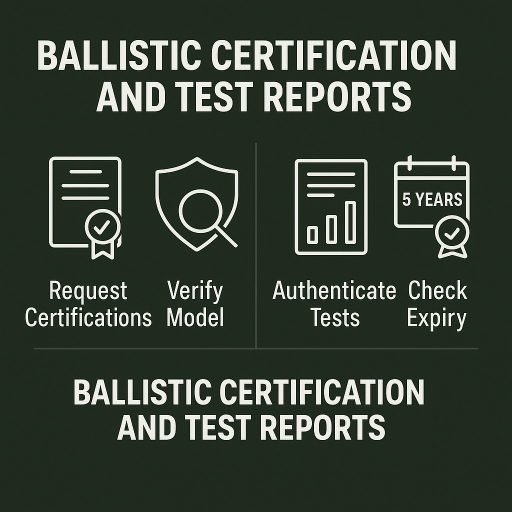
Certifications form the foundation of tender approval. Procurement teams should request and authenticate NIJ 0101.06/0101.07, STANAG 2920, and ISO 9001/14001 documents. One critical step is verifying that the certification applies to the exact product model and configuration being submitted for bidding — many tender rejections occur because suppliers submit certificates for unrelated models.
Ballistic test reports must include:
- Batch/lot identification numbers
- Ammunition type & test velocity
- Back-Face Deformation (BFD) results
- Impact location & multi-hit test pattern
- V50 data (for STANAG 2920)
- Official laboratory stamp, signatures, and date
These records verify the ballistic integrity, consistency, and traceability of the protective equipment being offered.
Learn more about testing standards in Ballistic Testing and Certification.
Manufacturing Traceability and Quality Audits
A reliable supplier must maintain complete traceability from raw material sourcing to final ballistic inspection. Government tenders should include factory audits that focus on material logs, batch-tracking systems, and ISO procedures.
ArmorGuard maintains digital traceability for every production batch, enabling end-to-end visibility and rapid quality verification. To understand OEM factory requirements, read “How to Choose a Reliable Body Armor OEM Factory in Asia.”
Contract and Documentation Compliance
Government tenders require comprehensive and compliant documentation. Missing or incorrect documents often lead to delays or rejection. Procurement teams must review all the necessary paperwork, including EUCs, export licenses, ballistic certifications, packing lists, and delivery schedules.
Documentation should match the tender specifications exactly, including armor models, NIJ levels, quantities, and warranty terms.
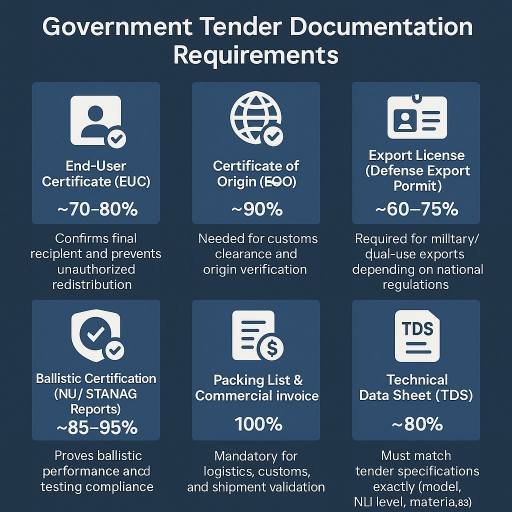
Government Tender Documentation Requirements
| Document Type | Requirement Rate (Industry Estimate) | Purpose / Notes |
| End-User Certificate (EUC) | ~70–80% | Confirms the final recipient and prevents unauthorized redistribution. |
| Certificate of Origin (COO) | ~90% | Needed for customs clearance and origin verification. |
| Export License (Defense Export Permit) | ~60–75% | Required for military/dual-use exports depending on national regulations. |
| Ballistic Certification (NIJ / STANAG Reports) | ~85–95% | Proves ballistic performance and testing compliance. |
| Packing List & Commercial Invoice | 100% | Mandatory for logistics, customs, and shipment validation. |
| Warranty & Compliance Statement | ~60–70% | Required for framework contracts and long-term defense procurement. |
| Technical Data Sheet (TDS) | ~80% | Must match tender specifications exactly (model, NIJ level, materials). |
Common Mistakes in Tender Evaluation
Tender committees occasionally overlook critical details during the evaluation process. Below are the most common mistakes observed across global defense procurement projects:
❌ Approving tenders without verifying recent NIJ/STANAG test results.
❌ Relying solely on supplier claims without documentation and cross-checking.
❌ Ignoring manufacturing traceability or material batch inconsistencies.
❌ Accepting incomplete export documentation, leading to customs delays.
❌ Failing to evaluate long-term OEM capacity for follow-up orders.
For understanding tactical product performance differences, refer to Top Ballistic Protection Solutions for Police and Military Units.
Why ArmorGuard Meets Tender Compliance Requirements
ArmorGuard’s government procurement framework integrates NIJ-compliant testing, ISO-governed production, and documented traceability across all ballistic product lines. This ensures verifiable data, certified materials, and transparent quality reports support each tender submission.
Our proven track record across police, military, and special operations units worldwide reflects our capability to meet complex government tender requirements. These strengths position ArmorGuard as a preferred partner under the ballistic protection manufacturing ecosystem.