A technical guide by ArmorGuard comparing Aramid and UHMWPE materials used in ballistic armor manufacturing, focusing on strength, weight, flexibility, and field performance.
Why Material Selection Defines Ballistic Performance
In ballistic protection design, the material determines both protection performance and end-user comfort.
Choosing between Aramid and UHMWPE directly affects weight, flexibility, and heat resistance—key variables for NIJ and STANAG compliance.
At ArmorGuard, all ballistic materials are sourced through certified international supply chains, ensuring verified tensile strength, areal density, and traceability.
Our annual material utilization exceeds 200+ tons, spanning soft armor fabrics and complex composite layers, all backed by batch-level verification from accredited suppliers across Asia and Europe.
(Data Note: Specific supplier identities are confidential under client and material license agreements.)
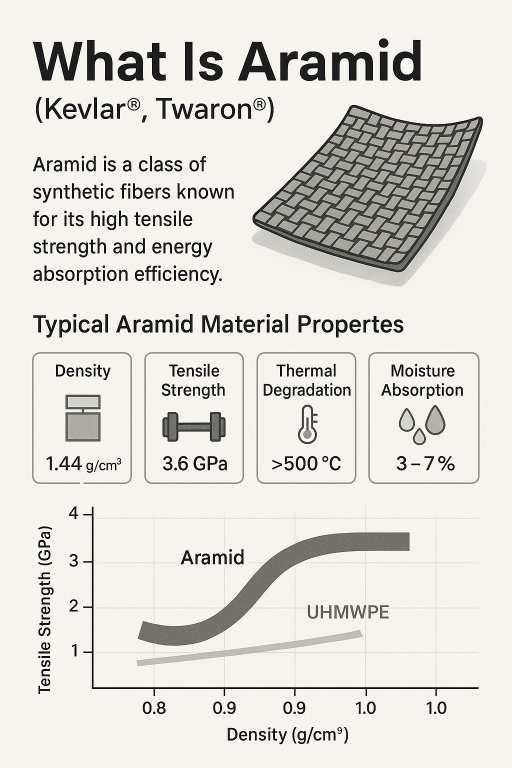
What Is Aramid (Kevlar®, Twaron®)
Aramid is a class of heat-resistant synthetic fibers characterized by a high tensile strength-to-weight ratio and excellent energy absorption efficiency.
It is the most established and widely used material in ballistic vest manufacturing, offering reliable multi-hit resistance, thermal stability, and dimensional consistency under operational stress.
At ArmorGuard, Aramid fabrics are precision-woven into flexible ballistic panels engineered to meet NIJ Level IIA–IIIA protection standards.
Each batch undergoes tensile and thermal resistance testing aligned with NIJ and STANAG methodologies within the ballistic testing and certification framework.
Typical Aramid Material Properties (Reference Values):
| Property | Typical Value | Notes |
| Density | 1.44 g/cm³ | Standard for Kevlar®/Twaron® aramid fibers |
| Tensile Strength | 3.6 GPa | High strength-to-weight ratio enables energy dispersion |
| Elongation at Break | ~2.8 % | Balances rigidity with impact absorption |
| Thermal Degradation Point | > 500 °C | Excellent heat resistance, suitable for ballistic lamination |
| Moisture Absorption | 3–7 % (by weight) | Moderate, manageable through coating or lamination |
| Typical Areal Density (Ballistic Panel) | 3.5–5.0 kg/m² | Depends on fabric layering and resin system |
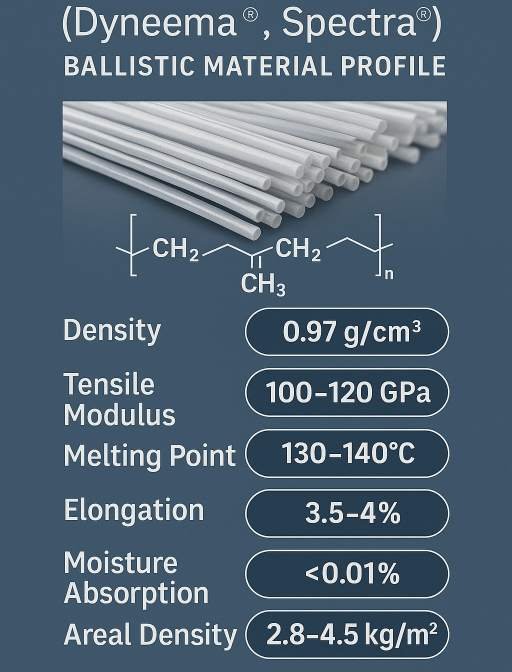
What Is UHMWPE (Dyneema®, Spectra®)
UHMWPE (Ultra-High-Molecular-Weight Polyethylene) is an ultra-light ballistic polymer engineered for superior impact resistance, energy absorption, and dimensional stability.
Its molecular chains are 10–100 times longer than conventional polyethylene, giving the material exceptional toughness and strength-to-weight efficiency.
UHMWPE delivers outstanding performance in both soft armor (flexible panels) and hard armor (rigid composite plates) where weight reduction is a tactical priority.
Compared to Aramid, UHMWPE offers 25–40% lower density, improving mobility and reducing long-term fatigue for soldiers and law enforcement officers.
However, because UHMWPE is a thermoplastic, temperature control and lamination precision are critical during production. ArmorGuard employs temperature-regulated molding and multi-layer cross-lamination in all UHMWPE-based OEM projects, ensuring consistency and long-term material integrity.
Typical UHMWPE Material Properties (Reference Values):
| Property | Typical Value | Notes |
| Density | 0.97 g/cm³ | 25–40% lighter than Aramid; key to high mobility |
| Tensile Strength | ~3.0 GPa | Excellent energy absorption under ballistic impact |
| Tensile Modulus | 100–120 GPa | High stiffness-to-weight ratio, ideal for rigid plates |
| Melting Point | 130–140 °C | Requires precise thermal control during lamination |
| Elongation at Break | 3.5–4.0 % | Adds flexibility for multi-hit and fatigue resistance |
| Moisture Absorption | <0.01 % | Excellent for maritime or humid operational environments |
| Areal Density (Ballistic Panel) | 2.8–4.5 kg/m² | Typical range depending on NIJ level and construction |
Aramid vs UHMWPE: Performance Comparison
The table below summarizes the key physical and operational differences between Aramid and UHMWPE materials used in ballistic armor:
| Property | Aramid (Kevlar®, Twaron®) | UHMWPE (Dyneema®, Spectra®) |
| Density (g/cm³) | 1.44 | 0.97 |
| Tensile Strength (GPa) | 3.6 | 3.0 |
| Melting / Degradation Point (°C) | 500+ | 130–140 |
| Moisture Absorption | Moderate | Minimal (<0.01%) |
| Heat Resistance | Excellent | Low–Moderate |
| Flexibility | Moderate | High |
| Typical Use | Soft armor, multi-hit panels | Lightweight plates, hybrid systems |
Hybrid Systems: Combining Both for Optimal Protection
Hybrid systems combine Aramid and UHMWPE layers to achieve balanced performance across multiple ballistic threat levels. By alternating the layers, engineers can combine Aramid’s heat stability with UHMWPE’s lightweight tensile properties, reducing trauma and improving comfort.
ArmorGuard engineers design hybrid stacks according to mission requirements — from concealed soft vests to full tactical carriers. These hybrid solutions form the foundation for the future of lightweight armor.
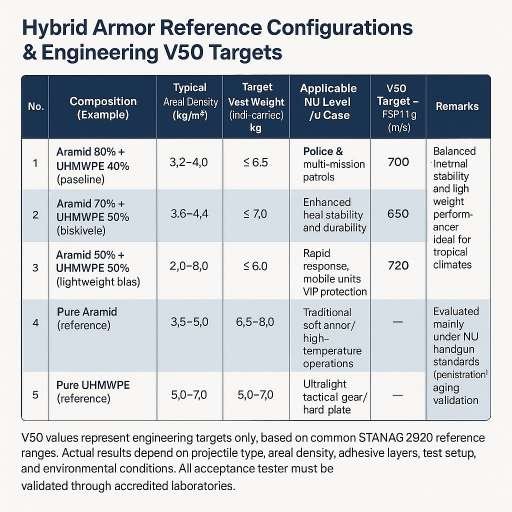
Hybrid Armor Reference Configurations & Engineering V50 Targets
| No. | Composition (Example) | Typical Areal Density (kg/m²) | Target Vest Weight (incl. carrier, kg) | Applicable NIJ Level / Use Case | V50 Target – FSP 1.1 g (m/s) | V50 Target – FSP 2.0 g (m/s) | Remarks |
| 1 | Aramid 60% + UHMWPE 40% (baseline) | 3.2–4.0 | ≤ 6.5 (soft armor, Level IIIA target) | Police & multi-mission patrols; base for composite plates | 700 | 560 | Balanced thermal stability and lightweight performance; ideal for tropical climates |
| 2 | Aramid 70% + UHMWPE 30% | 3.6–4.4 | ≤ 7.0 | Enhanced heat stability and durability | 650 | 520 | Higher heat resistance, slightly heavier construction |
| 3 | Aramid 50% + UHMWPE 50% (lightweight bias) | 2.8–3.6 | ≤ 6.0 | Rapid response, mobile units, VIP protection | 720 | 580 | Lower mass requires precise lamination and heat control |
| 4 | Pure Aramid (reference) | 3.5–5.0 | 6.5–8.0 | Traditional soft armor / high-temperature operations | — | — | Evaluated mainly under NIJ handgun standards (penetration/BFD) |
| 5 | Pure UHMWPE (reference) | 2.8–4.5 | 5.0–7.0 | Ultralight tactical gear / hard plate backers | — | — | Highly heat-sensitive; requires temperature-regulated forming & aging validation. |
How to Choose the Right Material for Your Mission Profile
Selecting between Aramid and UHMWPE depends on the user’s operational environment, threat type, and mobility requirements. The following general recommendations serve as a baseline for procurement and OEM configuration:
✅ Choose Aramid for high-heat environments, repeated impact zones, or when cost efficiency is a factor (e.g., police vests, covert wear).
✅ Choose UHMWPE for high-mobility operations where weight savings and long-duration comfort are priorities (e.g., military plate carriers).
✅ Choose Hybrid Systems when protection levels vary, combining both materials to balance coverage and comfort.
For mission-specific recommendations, see the top ballistic protection solutions for police and military units.
| Mission Type / Application | Recommended Material | Typical NIJ Level | Typical Vest / Plate Weight (kg) | Areal Density (kg/m²) | Key Strength | Limitations | Typical Use Examples |
| Urban Policing / Law Enforcement | Aramid | NIJ IIA – IIIA | 5.5 – 6.5 | 3.5 – 4.5 | Excellent heat resistance, multi-hit stability, and cost-effectiveness | Slightly heavier, moderate humidity absorption | Police patrol vests, covert armor, VIP security |
| Tropical / Maritime Patrols | UHMWPE | NIJ IIIA | 4.5 – 5.5 | 2.8 – 3.6 | Ultra-lightweight, minimal moisture absorption, fatigue reduction | Sensitive to heat, requires precise lamination | Coastal units, naval boarding teams, and private security |
| Infantry / Tactical Operations | Hybrid (Aramid + UHMWPE 60/40) | NIJ III – IV | 7.0 – 8.5 | 3.6 – 4.2 | Balanced multi-threat protection, improved trauma reduction | Slightly higher cost and process complexity | Military carriers, field operations, peacekeeping missions |
| High-Risk / Hot Zone Combat | Aramid-dominant Hybrid (70/30) | NIJ IV | 8.0 – 9.5 | 4.0 – 4.8 | Superior heat resistance and multi-hit capability | Heavier, reduced flexibility | Frontline armor plates, EOD, and anti-riot units |
| Quick Reaction / Mobility-Centric Teams | UHMWPE-dominant Hybrid (40/60) | NIJ III – IIIA | 6.0 – 7.0 | 3.0 – 3.8 | Lightweight with rifle-rated performance | Requires strict QC on lamination | Special forces, rapid deployment units, VIP escort teams |
Why ArmorGuard’s Material Engineering Ensures Consistency
ArmorGuard integrates ballistic material selection into OEM and ODM processes to ensure consistency and compliance with certification requirements. Each production batch undergoes pre-test verification, V50 validation, and random QA audits. By maintaining internal testing capability and global material sourcing partnerships, ArmorGuard guarantees stable performance for every project.
Explore our OEM & ODM solutions for complete customization and certified ballistic options.