An in-depth comparison guide by ArmorGuard for tactical procurement teams and ballistic product designers.
Why Material Choice Matters in Ballistic Protection
The selection of ballistic materials defines how body armor performs under real threat conditions—directly influencing its weight, flexibility, and protection rating.
Modern ballistic engineering focuses on optimizing material density, tensile strength, and energy absorption to meet evolving NIJ protection standards without compromising operator mobility.
At ArmorGuard, material science is integrated into every manufacturing stage—from fiber selection and layer configuration to lamination, forming, and ballistic validation. This ensures consistent quality, full traceability, and performance reliability across every production batch.
By balancing lightweight comfort with mission-grade durability, ArmorGuard delivers armor systems engineered for both tactical effectiveness and extended field wear—ready to be customized through our OEM and ODM ballistic programs.
What Is Aramid? (Kevlar®, Twaron®)
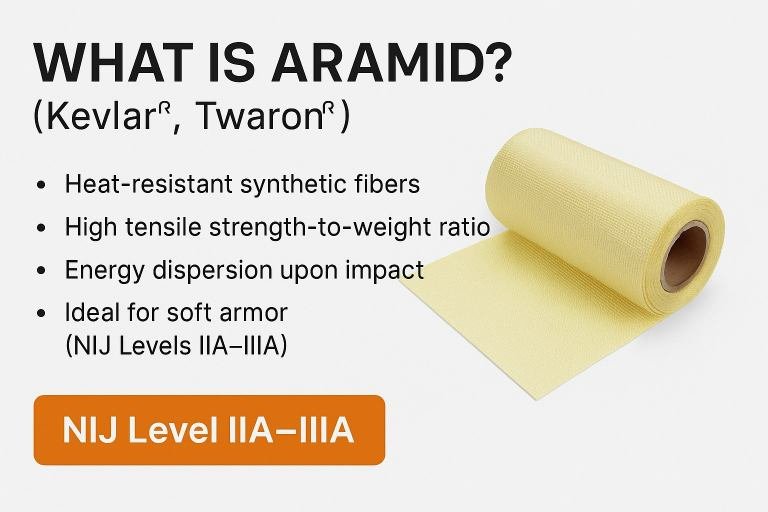
Among ballistic fibers, Aramid remains the most proven and widely adopted solution for soft body armor.
These heat-resistant synthetic fibers—commonly branded as Kevlar® or Twaron®—offer a high tensile-strength-to-weight ratio, enabling excellent energy dispersion when struck by ballistic projectiles.
Aramid fabrics are woven into flexible, lightweight sheets that absorb and distribute kinetic energy upon impact, making them ideal for NIJ Level IIA–IIIA soft armor applications such as police vests and covert protective gear.
At ArmorGuard, Aramid-based armor systems are developed and validated through on-demand ballistic testing conducted in accordance with NIJ and STANAG methodologies.
Specific material parameters—such as tensile strength, density (g/cm³), and thermal resistance (°C)—are verified as required by each client project.
What Is UHMWPE? (Dyneema®, Spectra®)
UHMWPE is an ultra-light ballistic polymer fiber recognized for its exceptional impact resistance, high tensile efficiency, and minimal moisture absorption.
Compared to Aramid, UHMWPE is approximately 25–40% lighter, offering significant advantages in mobility, comfort, and fatigue reduction during extended missions.
UHMWPE performs best in hybrid or hard-plate configurations, where its high tensile strength and low density combine to achieve adequate rifle-rated protection.
Because the material is thermoplastic, its ballistic integrity depends heavily on controlled lamination, heat pressure, and testing precision.
At ArmorGuard, UHMWPE-based armor systems are developed and verified through on-demand ballistic testing in accordance with NIJ 0101.06, 0101.07, and STANAG 2920 protocols—ensuring that performance parameters meet the specific operational requirements of each client project.
| Property | Typical Range / Unit | Notes |
| Density (g/cm³) | 0.93–0.98 | Among the lowest of ballistic fibers |
| Melting Point (°C) | ~130–140 | Thermoplastic; sensitive to heat during forming |
| Tensile Modulus (GPa) | 100–120 | High stiffness per weight ratio |
| Thickness Range (mm) | 5–25 | Depending on the armor type and NIJ level |
| Moisture Absorption | <0.01% | Excellent for humid or maritime conditions |
Hybrid Systems: Combining the Best of Both Worlds
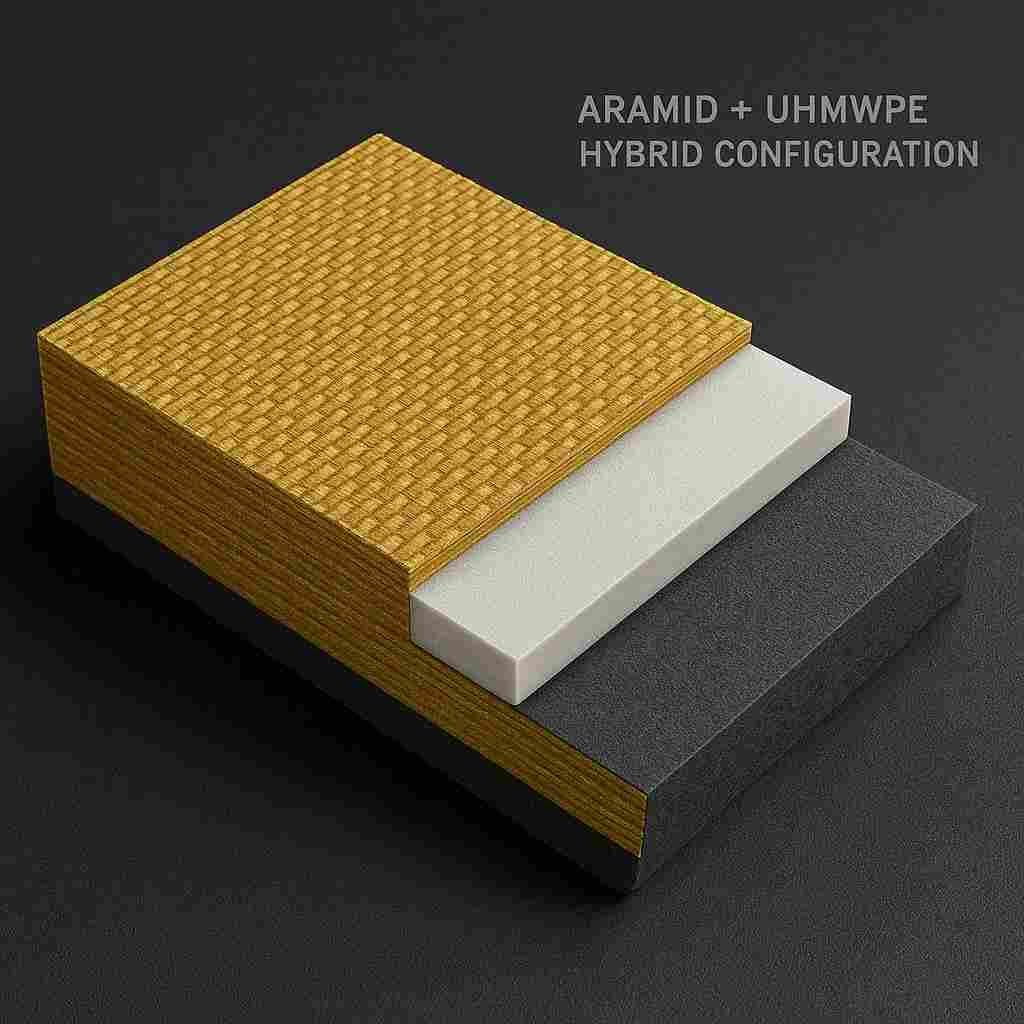
Hybrid ballistic systems integrate Aramid and UHMWPE layers within a single armor configuration to achieve the optimal balance between weight reduction, energy absorption, and multi-hit resistance.
By strategically alternating these materials, engineers combine the thermal stability and durability of Aramid with the lightweight tensile strength of UHMWPE, resulting in superior performance across a broad range of ballistic threats.
Hybrid armor designs maintain flexibility and wearer comfort while significantly improving trauma mitigation and heat resistance compared to single-material systems.
This layered approach allows ArmorGuard to tailor each configuration to meet client-specific NIJ or STANAG requirements, ensuring that protection and ergonomics align with the intended mission profile.
In addition to performance advantages, hybrid systems support sustainability goals by optimizing material use and extending product lifespan—key considerations in next-generation ballistic manufacturing.
| Layer Configuration | Composition Example | Key Benefit |
| Front Strike Layer | Aramid woven sheet | Heat resistance, impact dispersion |
| Intermediate Layers | UHMWPE cross-laminated fabric | Lightweight ballistic absorption |
| Backing Layer | Aramid composite or foam reinforcement | Blunt force and trauma reduction |
| Typical Ratio | ~60% Aramid + ~40% UHMWPE | Balanced flexibility and stopping power |
Aramid vs. UHMWPE: Detailed Comparison Table
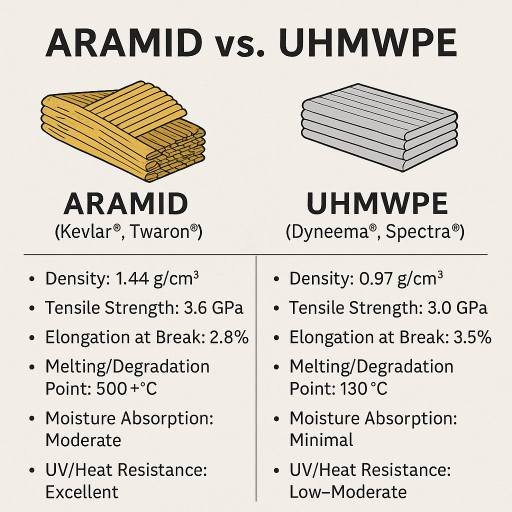
The table below compares the key performance characteristics of Aramid and UHMWPE fibers commonly used in ballistic armor manufacturing.
Values represent typical industry reference ranges based on certified supplier data (e.g., DSM, Teijin) and standardized test conditions.
Actual results may vary depending on lamination method, fabric orientation, and testing environment.
ArmorGuard conducts on-demand ballistic testing for every material configuration to verify performance in accordance with NIJ and STANAG standards.
| Property | Aramid (Kevlar®, Twaron®) | UHMWPE (Dyneema®, Spectra®) | Interpretation for Armor Design |
| Density (g/cm³) | 1.44 | 0.97 | UHMWPE is ~30% lighter, improving mobility. |
| Tensile Strength (GPa) | 3.6 | 3.0 | Both offer high strength; Aramid maintains stiffness at high temperatures. |
| Elongation at Break (%) | 2.8 | 3.5 | UHMWPE provides greater flexibility and energy dispersion. |
| Melting / Degradation Point (°C) | 500+ | 130 | Aramid withstands heat better; UHMWPE requires controlled lamination. |
| Moisture Absorption | Moderate | Minimal | UHMWPE resists humidity, ideal for maritime or tropical use. |
| UV / Heat Resistance | Excellent | Low–Moderate | Aramid maintains integrity under sunlight or high temperatures. |
| Relative Cost | Medium | High | UHMWPE’s processing adds cost, balanced by weight savings. |
How to Choose the Right Material for Your Application
Selecting the right ballistic material begins with understanding the mission profile, threat environment, and mobility requirements.
Each material family—Aramid, UHMWPE, and Hybrid Systems—offers unique advantages in protection level, weight, and ergonomics.
For procurement teams, the key is balancing comfort, coverage, and certification requirements rather than over-specifying armor beyond mission needs. ArmorGuard assists clients in defining these parameters during the OEM and R&D configuration phase, ensuring each solution aligns with NIJ and STANAG standards.
General Recommendations:
- Aramid: Best suited for soft armor applications requiring flexibility, heat resistance, and covert wear (e.g., police vests, security operations).
- UHMWPE: Ideal for rifle-rated armor plates or tactical carriers where lightweight mobility and fatigue reduction are critical.
- Hybrid Systems: Preferred for multi-threat missions combining handgun and rifle protection, offering a balance of flexibility, trauma resistance, and coverage.
As ballistic threats continue to evolve, the choice of material remains the foundation of reliable protection.
Whether through Aramid’s proven durability, UHMWPE’s lightweight efficiency, or hybrid systems’ adaptive balance, each solution represents a different intersection of performance, mobility, and mission design.
At ArmorGuard, we go beyond standard material selection—integrating engineering, testing, and OEM manufacturing into a unified ballistic production framework.
Every configuration is validated through on-demand NIJ and STANAG ballistic testing, ensuring that armor systems meet not only technical requirements but also the operational realities faced by defense and law enforcement personnel.
As defense procurement standards rise worldwide, ArmorGuard continues to pioneer flexible, scalable, and client-driven ballistic manufacturing—offering mission-ready protection for the next generation of tactical gear. Explore our OEM & ODM Solutions to configure your next ballistic project with verified performance and traceable certification.