Why Material Choice Matters in Tactical Gear
For tactical gear manufacturers and procurement officers, the fabric you choose isn’t just about texture—it defines performance, durability, and compliance. Among all materials, Cordura® stands out as the gold standard. But should you choose 500D or 1000D?
Understanding the difference between these two grades of Cordura® is critical, especially when designing NIJ-certified plate carriers, IRR-compliant uniforms, or bidding on government tenders.
For a complete manufacturing perspective, see our OEM tactical gear manufacturer guide.
What Is Cordura® and Why Is It Used?
Cordura® is a brand of high-performance nylon known for:
- Excellent abrasion resistance
- Lightweight strength-to-weight ratio
- Compatibility with IRR treatment and waterproof coatings
- Global recognition in defense, law enforcement, and private security
Both 500D and 1000D Cordura® are widely used in tactical vests, pouches, plate carriers, and packs—but they offer different performance characteristics.
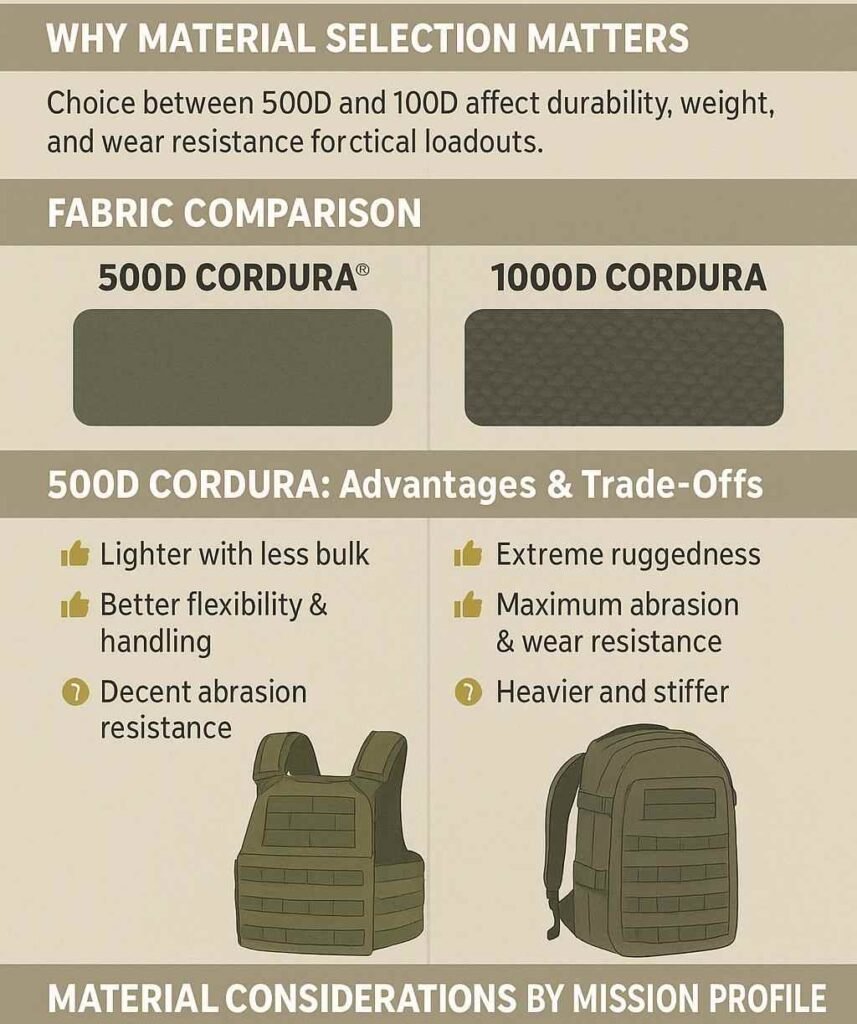
500D vs 1000D Cordura®: Side-by-Side Comparison
| Feature | 500D Cordura® | 1000D Cordura® |
| Durability | High (sufficient for urban missions) | Very High (resists field abrasion) |
| Weight | Lightweight (saves fatigue) | Heavier (adds endurance, reduces tear) |
| Flexibility | More pliable, comfortable | Stiffer, rugged |
| Ideal Use | Urban, law enforcement, light missions | Military, remote deployments |
| IRR Treatment | Fully compatible | Fully compatible |
| Cost | Slightly lower | Slightly higher |
Buyer Tip: Many OEM clients mix both fabrics—using 500D for vests and belts, and 1000D for high-wear zones, such as shoulders or mag pouches.
Want to learn how fabric choice affects the IR signature? Read: What Is IRR-Compliant Tactical Gear
How to Choose the Right Material Based on Mission Profile
Your end-use should determine your material spec. Here’s how:
✅For Urban Security or VIP Protection
- Use: Lightweight 500D
- Why: Offers enough strength, lower fatigue, and more comfort
- Recommended For: Discreet protection units, law enforcement patrols
✅For Military or Remote Site Contractors
- Use: 1000D or 500D/1000D hybrid
- Why: Added abrasion resistance, field longevity
- Recommended For: Infantry, private security contractors, maritime security
For loadout examples by role, see: Top Tactical Gear Items Every Private Security Contractor Needs
How OEM Manufacturers Work with Cordura®
At ArmorGuard, we source directly from certified Cordura® mills and provide:
- IRR-treated Cordura® (500D/1000D) with color options (Ranger Green, Coyote, MultiCam®)
- Batch-level quality testing with tear, abrasion, and IR reflection metrics
- Custom blend support (e.g., 420D + 1000D reinforcements)
- Documentation: COA, lab test reports, tender compliance packages
For contract-focused projects, see: How to Prepare Tactical Gear for Government Tender Requirements
Final Considerations Before Specifying Fabric
✅ Checklist for Procurement Teams:
- Have you matched material to mission risk?
- Do you have access to treated IRR-compatible Cordura®?
- Will the design integrate with NIJ or IRR-certified components?
- Is your OEM able to mix deniers for optimized builds?
Tactical Fabric Should Be Strategic
The decision between 500D and 1000D Cordura® isn’t about “better or worse”—it’s about fitness for purpose. In tactical procurement, success often depends on tailoring every spec to operational need.
Still deciding on the right material for your following product? Let our OEM consultants guide you through the prototyping and fabric testing process.