A step-by-step guide by ArmorGuard for defense agencies, law enforcement procurement teams, and tactical equipment distributors.
Why Procurement Standards Matter
Government and defense procurement of ballistic armor demands strict compliance with international protection standards such as NIJ and STANAG.
Every certified vest, plate, and carrier must pass defined testing, documentation, and durability benchmarks to ensure operational safety and traceability.
At ArmorGuard, we follow these standards as the foundation of our manufacturing system. Although the company is newly established, its engineering and quality teams are composed of industry specialists with years of experience in tactical and defense-grade production.
Our processes are designed to align with NIJ 0101.06/0101.07, STANAG 2920, and regional procurement criteria—ensuring that accredited third-party laboratories can validate every batch upon client request.
As we expand our capabilities, ArmorGuard is building partnerships with testing institutes and certification bodies across Asia, the Middle East, and Europe to support future government procurement projects with verified, mission-ready ballistic systems.
Understanding NIJ Certification and Compliance
The National Institute of Justice (NIJ) defines the global benchmark for ballistic resistance in personal armor through standards such as NIJ 0101.06 and the upcoming 0101.07. These define protection levels from IIA to IV, specifying the ammunition type, test velocity, and back-face deformation (BFD) to ensure performance consistency across armor systems.
At ArmorGuard, our ballistic manufacturing processes are designed in complete alignment with NIJ and STANAG testing methodologies. While formal certification is performed on a project-specific basis, every product can be submitted for third-party NIJ-compliant testing upon client request. This approach ensures flexibility for government procurement, OEM programs, and international compliance requirements.
ArmorGuard is currently expanding its testing partnerships with accredited ballistic laboratories in Asia, the Middle East, and Europe, ensuring that future production runs achieve traceable, mission-grade NIJ verification from prototype to final validation.
Key Factors in Armor Selection for Government Use
Selecting the proper body armor for government procurement requires a careful balance between mission objectives, operational threat level, environmental conditions, and budget allocation.
Procurement teams should evaluate not only ballistic performance, but also wearability, maintenance logistics, and long-term service life.
At ArmorGuard, we assist agencies and OEM partners in structuring their armor evaluation processes in accordance with NIJ and STANAG standards.
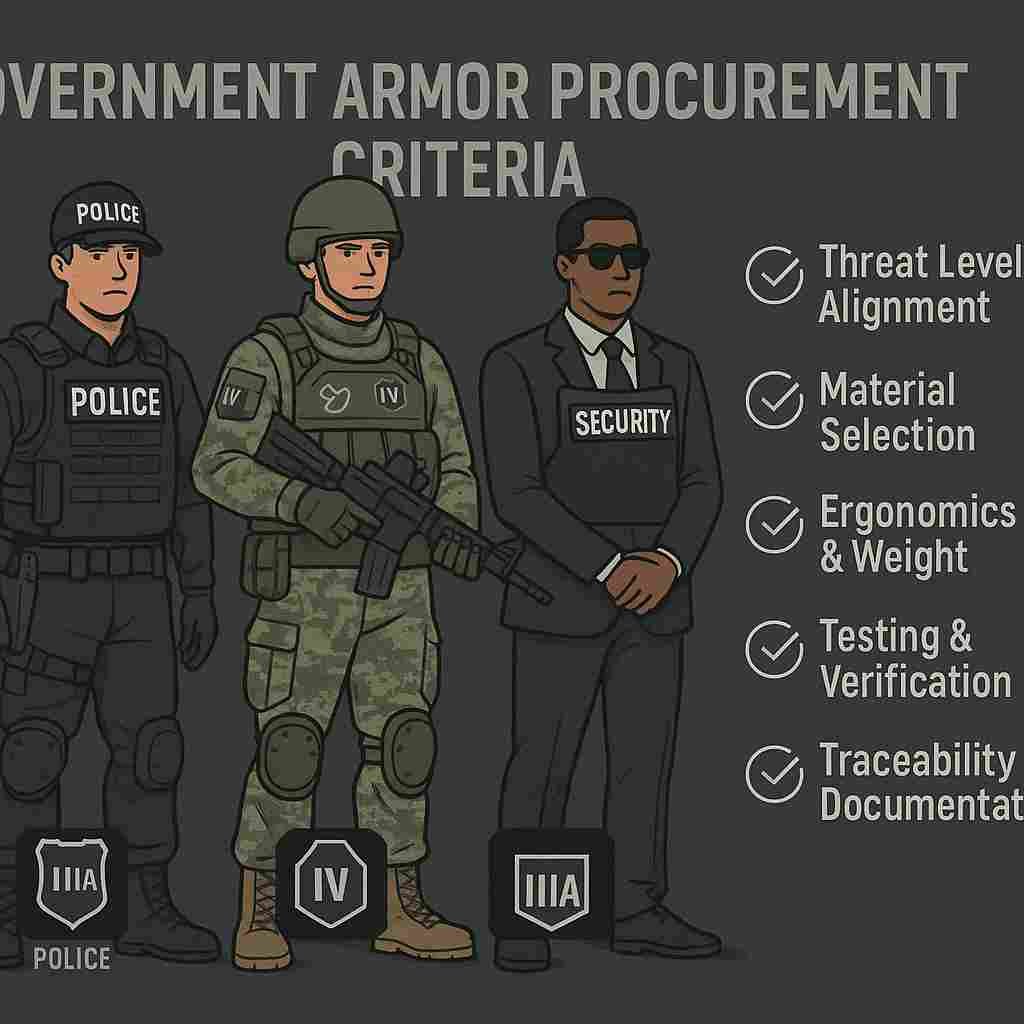
The following key factors serve as a framework for technical and procurement decisions:
✅ Threat Level Alignment — Match the NIJ or STANAG class to mission requirements (e.g., handgun, rifle, or armor-piercing threats).
✅ Material Selection — Compare Aramid, UHMWPE, and hybrid configurations according to required protection and mobility, see Ballistic Materials Compared.
✅ Ergonomics & Weight — Ensure comfort and fatigue resistance during extended wear, especially in warm climates or long patrols.
✅ Testing & Verification — Specify NIJ-compliant testing and validation through accredited laboratories. ArmorGuard provides on-demand material testing as part of its OEM development service.
✅ Traceability & Documentation — Require serial number registration, lot identification, and quality control records to support post-delivery audits and inventory management.
By applying these principles, government and law-enforcement buyers can select armor systems that balance mission-ready protection with logistical efficiency and procurement accountability.
Procurement Specifications and Documentation Requirements
All government contracts for ballistic armor should include detailed documentation to verify product compliance. ArmorGuard provides comprehensive certification and traceability packages that meet the latest NIJ and ISO standards. Typical documentation includes the following:
- Certificate of Conformance (CoC)
- Ballistic Test Report (including V50, BFD, multi-hit data)
- Lot Traceability Record and Serial Number Register
- Material Certificates (Aramid/ UHMWPE supplier lot documentation)
- Final Quality Control and Inspection Report
- Export/ ISO Certificates as required
For testing and compliance audit procedures, see ballistic testing requirements.
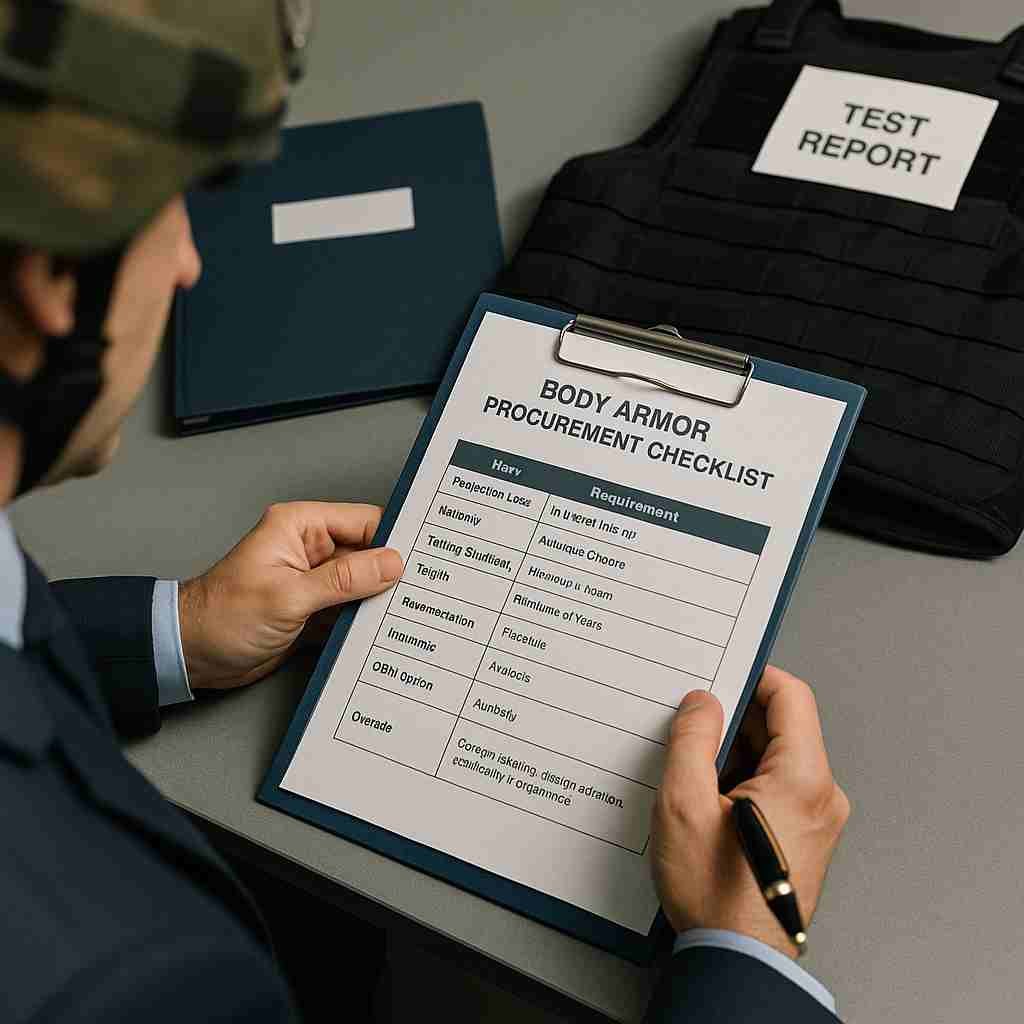
Body Armor Procurement Checklist (For Tenders & RFQs)
Government agencies and institutional buyers can use the following checklist as a baseline for preparing a Request for Quotation (RFQ) or tender documentation related to ballistic protection equipment.
It helps ensure that specifications are traceable, standardized, and verifiable in accordance with NIJ /STANAG protocols.
At ArmorGuard, we support procurement teams by providing customized technical sheets, testing documentation, and OEM configuration support to align with regional compliance requirements.
| Item | Requirement | Description / Notes |
| Protection Level | NIJ Level IIA – IV | Match threat environment and mission profile. |
| Material Composition | Aramid / UHMWPE / Hybrid | Specify preferred fiber type and configuration for mobility vs. protection. |
| Testing Standard | NIJ 0101.06 / 0101.07 / STANAG 2920 | Define test reference; ArmorGuard supports NIJ-compliant third-party testing upon request. |
| Weight Limitation | Specify maximum areal density (kg/m²) | Optimize comfort and load distribution for extended missions. |
| Documentation Package | Certificate of Conformity (CoC), ballistic test report, and traceability record | Ensure auditability and post-delivery validation. |
| Warranty Period | Minimum 5 years | Cover both material integrity and workmanship under standard use. |
| OEM / ODM Option | Available | Custom labeling, design adaptation, and ballistic configuration per contract terms. |
| Compliance Note | NIJ / STANAG alignment | All configurations are designed for verification under accredited testing conditions. |
Common Pitfalls in Body Armor Procurement
Even well-structured tenders can encounter compliance or performance issues if key aspects are overlooked. Below are common mistakes observed in government and agency purchases:
❌ Accepting non-certified armor without valid NIJ/ STANAG reports.
❌ Mismatching the NIJ level with the threat assessment data.
❌ Lack of material traceability and missing serial verification.
❌ Ignoring ergonomic testing or fit evaluations.
❌ Choosing non-OEM suppliers without documented production control — see OEM tactical armor production.
ArmorGuard’s OEM Support for Government Tenders
ArmorGuard supports government procurement officers and defense contractors through end-to-end OEM and ODM production. Our teams assist with specification drafting, certification preparation, and pre-delivery inspection. This ensures every unit meets contractual, legal, and operational expectations. Learn more about ArmorGuard’s OEM & ODM solutions.
Building Procurement Confidence with ArmorGuard, as global defense procurement standards continue to evolve, transparency and certification are becoming as critical as protection itself.
ArmorGuard’s ballistic manufacturing framework is built around traceability, third-party verification, and mission-specific design, enabling agencies and OEM partners to source armor with confidence. From NIJ-compliant testing to OEM customization and documentation packages, ArmorGuard delivers a reliable foundation for modern defense and law enforcement procurement.
Contact ArmorGuard’s OEM Support Team to configure a verified ballistic solution for your next government project.