Why Government Tenders Are High-Risk, High-Reward
Securing a government tender for tactical gear can unlock high-volume, multi-year contracts—but the process is unforgiving. Procurement officers must navigate strict timelines, certification requirements, documentation checks, and logistical protocols. A single missing test report or labeling mismatch can disqualify your bid.
To compete seriously in this space, manufacturers and distributors must prepare their gear and paperwork to meet legal, operational, and quality standards from the first submission.
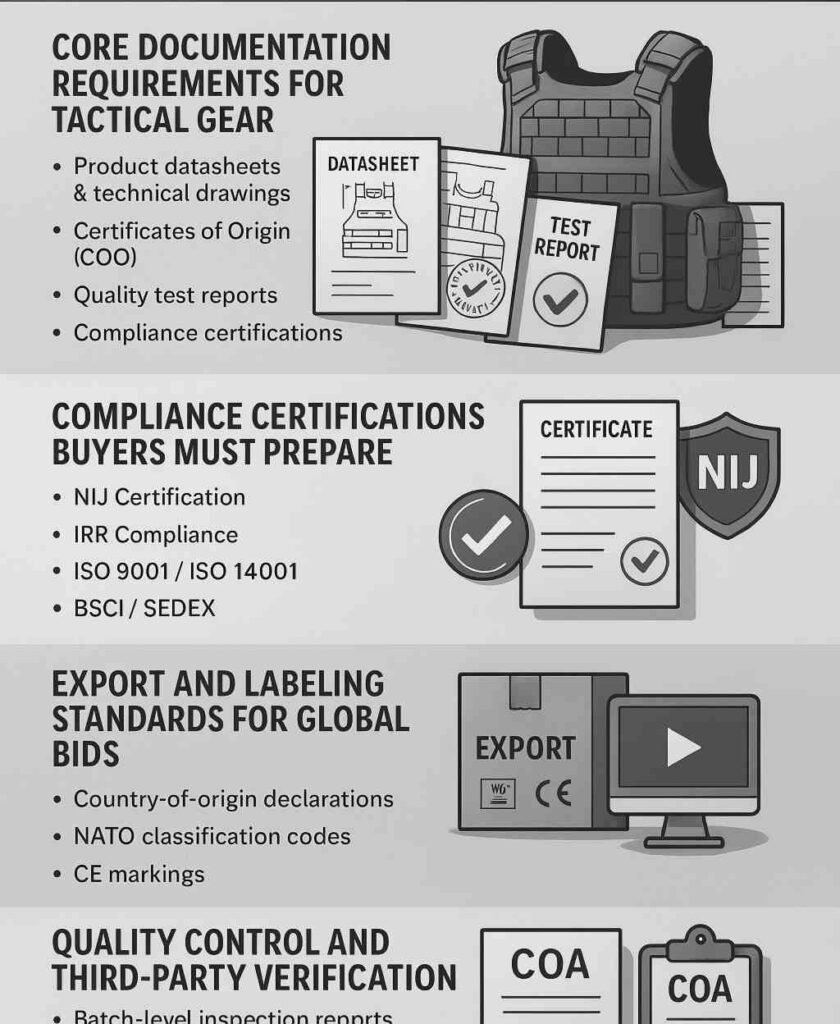
Core Documentation Requirements for Tactical Gear
- Most tactical gear tenders require the following baseline documents:
- Product datasheets with part numbers and dimensions
- Technical drawings (DXF, PDF, or CAD formats)
- Certificates of Origin (COO)
- Quality test reports (ballistic, IRR, tensile strength)
- Compliance certifications (NIJ, IRR, ISO, BSCI)
- Factory audit reports (optional but recommended)
Tenders issued by NATO-aligned, EU, or US agencies often come with particular documentation templates. Working with an experienced OEM tactical gear manufacturer ensures your documentation aligns with international standards from the outset.
Compliance Certifications Buyers Must Prepare
Certification isn’t a box-ticking exercise—it’s the backbone of government tender credibility. Most tactical gear categories fall under the following requirements:
- NIJ Certification: Required for ballistic products like body armor and plate carriers. See our full breakdown on NIJ-certified plate carriers.
- IRR Compliance: Mandatory for night-vision camouflage standards. Learn more in our IRR-compliant tactical gear guide.
- ISO 9001 / ISO 14001: Quality and environmental system standards. Often required at the factory level.
- BSCI/SEDEX: Social compliance certifications are increasingly requested in EU bids.
These documents must come from third-party labs or officially accredited testing institutions—not self-declared claims.
Export and Labeling Standards for Global Bids
One of the most overlooked aspects of government tender prep is export compliance. Even if the gear itself is compliant, labels, shipping markings, and Harmonized System (HS) codes must also conform to:
- Country-of-origin declarations
- Dual-use item labeling (where applicable)
- NATO supply classification codes
- CE markings (for applicable components)
Failure to meet EU or US labeling requirements can result in customs delays or outright rejection of goods—even after a bid has been won.
Quality Control and Third-Party Verification
Beyond documents, tenders require real-world proof of quality. Expect to provide:
- Batch-level quality inspection reports
- Sample test result videos or NIR performance clips
- Certificates of Analysis (COA) per lot or shipment
- Product traceability records (date, batch, origin)
Our comprehensive tactical gear certification checklist outlines the steps to prepare each item for submission.
How ArmorGuard Supports Tender-Focused Clients
ArmorGuard provides turnkey support for tactical gear bids:
- OEM-ready documentation (CAD files, spec sheets, compliance records)
- Rapid prototyping for sample evaluation (7–10 days)
- NIJ and IRR-compliant product sourcing
- ISO-certified production lines in Southeast Asia
- Export-prepared documentation with all HS codes and labeling
We also work directly with buyers to pre-fill technical spec sheets and simulate lab testing video footage when required.
Checklist for Tactical Tender Success
Before submission, ensure your bid includes:
- Product datasheets & CAD drawings
- NIJ and/or IRR certifications
- COO, COA, and factory compliance records
- Export label and HS code confirmation
- Batch-level testing or video documentation
- Supplier agreement with delivery timeline
For manufacturers and suppliers, early coordination with your OEM partner is critical. Please explore our complete guide on OEM tactical gear manufacturers to avoid common tender pitfalls and win with confidence.