A comprehensive guide by ArmorGuard to help tactical gear brands, defense distributors, and procurement teams choose between OEM and ODM manufacturing models for ballistic protection equipment.
Why the OEM/ODM Model Matters in Tactical Manufacturing
In the defense and tactical gear industry, manufacturing models define competitive advantage. Choosing between OEM and ODM determines not only your cost structure and delivery time, but also the level of control you retain over design, certification, and long-term brand differentiation.
At ArmorGuard, both models are integrated within one unified ballistic protection manufacturing ecosystem:
OEM partnerships emphasize the precise execution of client specifications and compliance standards. At the same time, ODM collaborations focus on innovation, providing ready-to-market ballistic and tactical solutions engineered by our in-house design and R&D teams.
This dual-model flexibility allows our partners—ranging from government contractors to tactical brands—to scale production efficiently, reduce certification complexity, and enter new markets with confidence.
(Data Note: OEM/ODM ratio details are referenced in Section — OEM Factory Evaluation.)
What Is OEM (Original Equipment Manufacturing)
OEM manufacturing means the client provides the design, technical drawings, and material requirements, while the factory focuses on production, assembly, and quality assurance. This model offers greater control for established tactical and defense brands that already have detailed product specifications and need reliable execution partners.
At ArmorGuard, our OEM system is built for international collaboration —providing design-for-manufacturing feedback, in-house ballistic verification, and documentation aligned with NIJ and ISO 9001 standards.
Although the facility is newly established, our engineering and QA teams consist of specialists with years of prior experience in ballistic and tactical production.
Rather than presenting past cases, ArmorGuard demonstrates its capability through structured OEM readiness programs, including:
- Design Simulation: CAD-based manufacturability review and material optimization.
- Trial Production Runs: Controlled sample lots for ballistic evaluation before scaling.
- Documentation Templates: Pre-formatted NIJ and ISO test documentation ready for client-requested submission.
- Export Readiness: Logistics partners and compliance framework already configured for EU, Middle East, and ASEAN markets.
This ensures that from the very first cooperation, clients receive the same procedural reliability and documentation quality expected from mature defense OEM suppliers.
(Data Note: Full production benchmarks and client typologies are provided in Section — OEM Factory Evaluation.)
What Is ODM (Original Design Manufacturing)
ODM manufacturing empowers the factory to lead product design, R&D, and ballistic configuration. Clients provide only the mission concept—such as protection level, environmental conditions, or target cost—and rely on the manufacturer to engineer a complete, market-ready solution.
At ArmorGuard, ODM projects are driven by our integrated design-to-validation framework, combining:
- Material Science Expertise – Hybrid fiber layering and energy absorption modeling tailored to threat levels.
- In-House R&D and Testing – Rapid prototype loops under controlled ballistic and ergonomic evaluation.
- Digital Design Collaboration – Clients co-develop in CAD and simulation platforms for faster design approval.
- Scalable Transition – Once validated, designs transfer seamlessly to NIJ-compliant mass production lines.
This model is ideal for emerging tactical brands seeking to enter the ballistic gear market quickly without building an internal engineering or certification team.
Rather than fixed project cycles, ArmorGuard’s ODM process emphasizes modular development — allowing clients to customize features, protection levels, or materials at any stage of the design journey.
(Data Note: For full R&D cycle references and pre-certification timelines, see Section — Inside a Ballistic Vest OEM Project.)
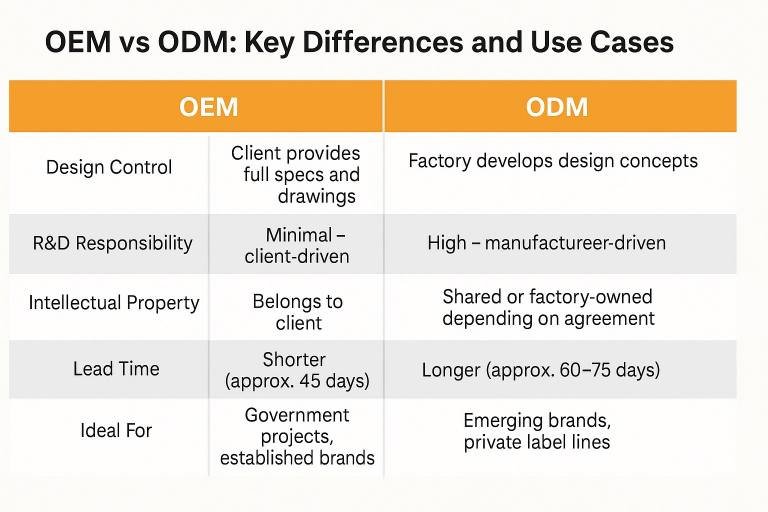
OEM vs ODM: Key Differences and Use Cases
The table below highlights the main distinctions between OEM and ODM models as applied in ballistic and tactical gear production.
| Category | OEM | ODM |
| Design Control | Client provides full specs and drawings | The factory develops design concepts |
| R&D Responsibility | Minimal – client-driven | High – manufacturer-driven |
| Intellectual Property | Belongs to the client | Shared or factory-owned, depending on agreement |
| Lead Time | Shorter (approx. 45 days) | Longer (approx. 60–75 days) |
| Ideal For | Established brands, government projects | Emerging brands, private label lines |
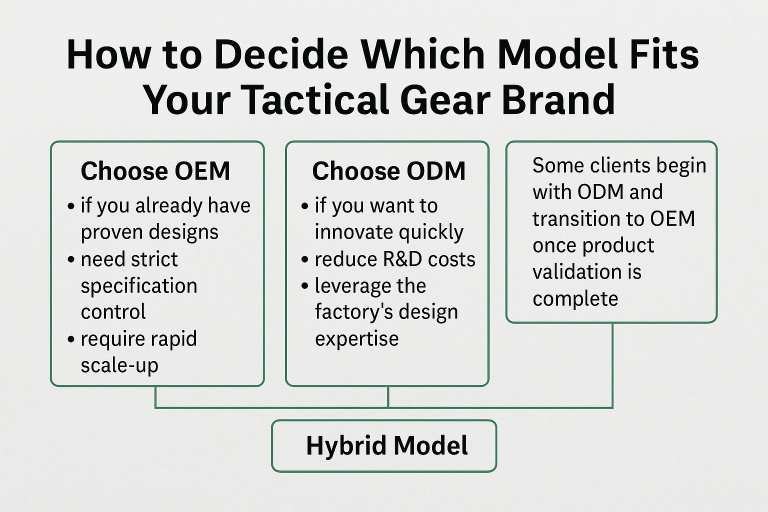
How to Decide Which Model Fits Your Tactical Gear Brand
Choosing between OEM and ODM depends on your strategic goals, budget, and production experience. Use the following framework to determine which model aligns best with your current growth stage:
✅ Choose OEM — if you already have proven designs, need strict specification control, and require rapid scale-up.
✅ Choose ODM — if you want to innovate quickly, reduce R&D costs, and leverage the factory’s design expertise.
✅ Hybrid Model — Some clients begin with ODM and transition to OEM once product validation is complete.
At ArmorGuard, several developing tactical and law enforcement brands in Asia and Europe start from ODM co-development, then move to OEM-exclusive contracts after initial field testing and NIJ verification.
Typical Transition Benchmark (Industry + ArmorGuard Reference):
| Stage | Description | Typical Duration | Outcome |
| ODM Phase | Co-developed product concept, 2–3 prototype rounds, and material optimization | 3–6 months | NIJ pre-test completed; design verified |
| Hybrid Phase | Client refines specifications; production under shared design rights | 1–2 months | Pilot batch delivered under joint QC |
| OEM Phase | Client assumes complete control with proprietary drawings and labeling | 6–12 months after ODM launch | Product certified and scaled for export |
(Data Note: Based on ArmorGuard’s current project roadmap and regional tender experience, actual timelines vary depending on certification scope and client readiness.)
Why ArmorGuard Offers Both Models Efficiently
ArmorGuard bridges OEM and ODM through an integrated R&D and testing ecosystem. Our engineers, ballistic technicians, and designers collaborate within a single workflow—from CAD modeling to live-fire testing—ensuring both innovation and compliance.
Clients benefit from flexible cooperation models, transparent data sharing, and certification-backed reliability. Whether you are launching a new tactical brand or scaling a government contract, ArmorGuard provides a manufacturing framework that adapts to your business goals. Discover more about our OEM & ODM solutions.