Patrol Operations: Endurance Over Hours
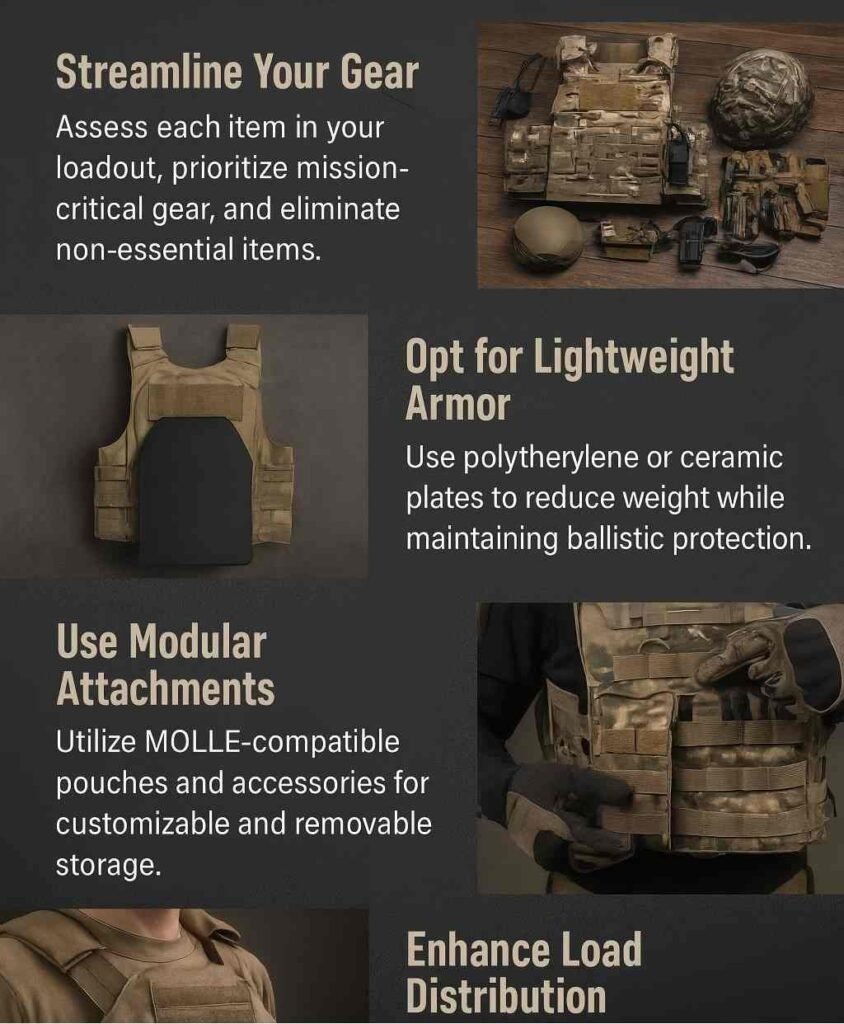
Patrol missions often span several hours or even days, requiring operators to remain mobile, alert, and responsive. In such conditions, every gram of weight makes a difference.
Loadout Strategy:
- Prioritize hydration bladders over multiple canteens.
- Integrate comms and battery packs into existing pouches
- Use ergonomic shoulder and waist straps to distribute weight
- Eliminate duplicate or redundant gear items
Patrol loadouts must support sustained movement without inducing fatigue, especially under hot, uneven terrain or in long-footprint security routes.
Urban Entry Teams: Speed + Coverage
Urban operations require maximum maneuverability and a low profile. Hallways, doorways, and vehicles limit movement — and bulky gear can slow down room-clearing or cause lethal delays.
Loadout Strategy:
- Use low-profile plate carriers with streamlined pouches
- Configure front-access medical gear (IFAKs, tourniquets)
- Mount only essential ammunition and tools on the chest and belt
- Keep comms earpiece-based to reduce headset bulk
Speed equals survivability in close-quarter battle. Innovative teams shed unnecessary weight without losing operational readiness — starting with a plate carrier that strikes a balance between fit, protection, and agility.
Recon & Mountain Units: Load-Carrying for Distance
Reconnaissance teams and mountain units operate in low-support environments where resupply may be impossible. Their gear must serve multiple functions while being optimized for extended marches.
Loadout Strategy:
- Choose lightweight soft armor or hybrid plates
- Integrate modular hydration and food pouches
- Mount packs higher for improved hip mobility on slopes
- Ensure balance to avoid tipping over rough terrain
Armorguard’s lightweight materials — such as UHMWPE and laser-cut 500D nylon — are the result of decades-long evolution in tactical armor material science, helping operators stay mobile in extreme terrain.
Multi-Day Missions: Adaptive Loadouts
For extended ops where objectives may shift, flexibility becomes paramount. Modular loadouts allow units to adapt gear to changing mission needs without repacking from scratch.
Loadout Strategy:
- Use quick-swap front flaps for different mission roles (e.g., breaching vs. comms)
- Distribute mission-critical gear across team members
- Utilize external MOLLE pouches for med/rescue tasks
- Built-in layered protection (removable groin/neck/shoulder pads)
Armorguard’s modular vests support mission-specific reconfiguration in minutes, enabling the same platform to perform across various environments.
Universal Truth: Less Weight, More Stamina
Across every mission type, the same rule applies: lighter loadouts lead to longer endurance, faster response times, and lower injury rates.
What to Eliminate:
- Excessive admin pouches
- Redundant secondary weapons/tools
- Heavy steel plates where NIJ-certified PE or ceramic armor would suffice — if you understand the correct ballistic level for your mission, you carry smarter, not heavier.
The goal isn’t to carry everything. It’s about having what matters — and holding it right.
Armorguard OEM Loadout Kits
Armorguard designs scalable OEM-ready loadout systems based on tactical roles:
| Role | Modular Kit Type | Features |
| Patrol Ops | Lightweight + Hydration Panel | Breathable mesh, low IRR, high mobility |
| Urban Entry/CQB | Quick-Release Plate Carrier | Front-access IFAK, slim side panels |
| Recon/Mountain | Extended Ops Harness + Plate | Balanced lumbar support, hydration routing |
| Multi-Mission OEM | Modular Flap + Add-on Armor | Swap-ready front panels, scalable protection |
Whether for private OEM brands or national tenders, Armorguard’s systems are built for mission-specific efficiency.
Efficiency is Tactical Superiority
A heavier operator is a slower operator. But tactical efficiency isn’t just about reducing weight — it’s about optimizing load distribution, mission focus, and operational safety.
Armorguard enables military, law enforcement, and OEM clients to design brighter, lighter, and more adaptive tactical gear. Because actual readiness isn’t just measured in armor levels — it’s measured in endurance, execution, and efficiency.