What Is Ballistic Protection?
Ballistic protection refers to the engineering and production of materials designed to resist or absorb the kinetic energy of bullets and fragments. Built in compliance with international ballistic protection standards, ArmorGuard utilizes lightweight fibers, hybrid composites, and ergonomic construction to safeguard soldiers, law enforcement officers, and tactical operators.
Ballistic protection is not only about stopping a round—it’s about achieving the optimal balance between safety, mobility, and comfort under mission-critical conditions.
✅ ArmorGuard conducts ballistic testing and certification on demand according to client requirements, ensuring that every product can be verified through third-party laboratories following NIJ or regional standards.

Global Standards: NIJ, STANAG, and Regional Equivalents
The National Institute of Justice (NIJ) defines ballistic protection levels from IIA to IV, each corresponding to specific ammunition types and test velocities.
- Level IIA / II: Designed to stop standard handgun rounds such as 9mm and .357 Magnum.
- Level IIIA: Withstands high-velocity handgun threats, tested up to .44 Magnum.
- Level III / IV: Rated for rifle and armor-piercing projectiles.
The STANAG 2920 standard, adopted by NATO and allied nations, evaluates V50 ballistic limits—the velocity at which 50% of fragments penetrate a test panel—and serves as a critical benchmark for military and defense applications.
Understanding these international and regional standards enables procurement officers and defense contractors to select armor systems that align with mission profiles, regulatory frameworks, and export control requirements.
✅ ArmorGuard currently manufactures ballistic protection products in compliance with NIJ and STANAG methodologies. While the company is newly established and has not yet completed formal certification, ArmorGuard provides on-demand ballistic testing and third-party verification according to customer and project needs.

Materials and Technology
Modern armor uses UHMWPE fibers rather than aramid fibers as its core ballistic materials. UHMWPE offers a higher strength-to-weight ratio, while Aramid provides superior thermal stability. Hybrid layering techniques improve flexibility without compromising protection.
The Ballistic Manufacturing Process
Producing mission-grade body armor requires precision and quality control at every stage of manufacture. ArmorGuard’s production workflow is engineered for repeatability and client-specific verification:
- Material selection: Specify and source high-performance fibers — certified aramid (e.g., Kevlar®) or UHMWPE (e.g., Dyneema®) — chosen to meet project targets for protection, weight, and durability.
- Layering & cutting: Multiple plies are cut using CNC or laser dies to ensure consistent overlap and full coverage.
- Lamination & forming: Plies are consolidated by controlled heat-press or vacuum lamination to produce soft panels or pressed rigid plates with predictable ballistic performance.
- Testing & validation: Batch-level checks include V50 fragment testing, back-face deformation (BFD) measurement, and multi-hit protocols; all testing is executed upon client specification, and third-party verification can be arranged.
- Assembly & ergonomics: Panels are integrated into carriers and vests with an emphasis on load distribution, wearer mobility, and long-duration comfort.
Operational note: ArmorGuard maintains dedicated ballistic workshops in Thailand with processes aligned to NIJ 0101.x and STANAG 2920 methodologies; we provide on-demand testing and third-party validation per customer requirements.
Environmental & Multi-Hit Testing Conditions
Testing includes conditioning cycles, temperature variation, and humidity exposure. To ensure reliability, panels undergo multi-hit validation. BFD and V50 data confirm real-world survivability under diverse scenarios.
OEM & ODM Solutions for Tactical Brands
ArmorGuard’s manufacturing model is built for flexibility.
ArmorGuard’s manufacturing model is built for flexibility—offering both OEM and ODM services to tactical brands, defense contractors, and government agencies worldwide.
OEM: We manufacture to your exact specifications, using certified materials and labeling, and package under your brand identity.
ODM: Our engineering team designs and develops complete ballistic protection products ready for private-label, law enforcement, or defense procurement use.
Through co-development, clients can define the protection level, cut pattern, color, and modular configuration. ArmorGuard’s engineers support every phase—from prototype fabrication to performance validation—ensuring each batch is tested in accordance with NIJ and STANAG protocols before shipment.
Team and Capability Statement:
Although ArmorGuard’s production base is newly established, our core technical and management teams are veterans of the tactical and defense manufacturing sector, bringing years of collective experience from leading ballistic and tactical equipment companies. This foundation allows ArmorGuard to deliver mission-ready, internationally compliant ballistic systems from day one.

Materials and Technology Behind Ballistic Armor
Two main fiber technologies dominate modern armor:
| Material | Description | Key Benefits |
| Aramid (Kevlar®, Twaron®) | High-tensile synthetic fiber with excellent heat resistance | Proven durability, stable under heat |
| UHMWPE (Dyneema®, Spectra®) | Ultra-high-molecular-weight polyethylene fiber | 30–40 % lighter, excellent energy absorption |
Hybrid designs combine both materials to maximize stopping power while reducing fatigue.
ArmorGuard’s R&D team also works with ceramic and composite plates for high-threat environments and anti-fragment layers for urban missions.
Quality Control and Ballistic Testing
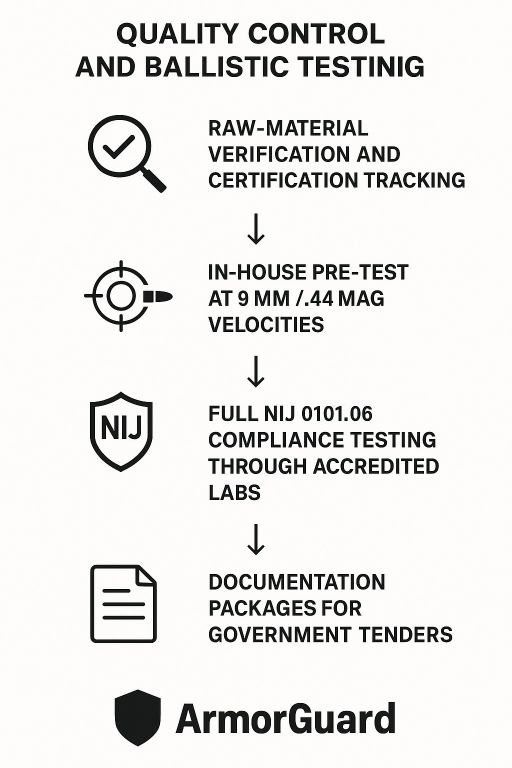
Every ArmorGuard product follows a traceable Quality Assurance Plan:
- Raw-material verification and certification tracking
- In-house pre-test at 9 mm / .44 Mag velocities
- Full NIJ 0101.06 compliance testing through accredited labs
- Documentation packages for government tenders
Each vest or plate includes serial tracking, inspection records, and ballistic test reports—essential for defense procurement audits.
Applications: From Military to Police Procurement
ArmorGuard ballistic systems are deployed by:
- Military units requiring modular plate carriers for high-threat operations
- Law enforcement agencies are using lightweight Level IIIA vests for urban patrol
- Private security and tactical brands seeking certified OEM production
The company supports procurement programs across Asia, the Middle East, Africa, and Europe, adapting specifications to regional climates, threat levels, and export regulations.
Why Choose ArmorGuard as Your Ballistic Protection Partner
Full-Spectrum Manufacturing: Soft armor, rigid plates, helmets, and shields under one roof.
- NIJ-Certified Testing: Each series is validated before delivery.
- OEM + ODM Flexibility: Tailor your design, label, and distribution model.
- Strategic Location: Thai facility near major shipping hubs ensures stable lead times.
- Global Export Expertise: Compliance with U.S., EU, and ASEAN defense standards.
Contact ArmorGuard Gear to develop certified ballistic protection solutions tailored to your tactical or defense mission.
FAQs about Ballistic Manufacturing
Q1. What is NIJ Level IIIA armor?
It is soft body armor designed to stop handgun rounds up to .44 Magnum at 436 m/s, offering the highest protection available in flexible vests.
Q2. What’s the difference between OEM and ODM production?
OEM means ArmorGuard builds according to your design; ODM means ArmorGuard provides a ready-made, certified design under your brand.
Q3. How are ballistic vests tested?
Samples are shot at calibrated velocities to measure penetration, deformation, and back-face energy.
Q4. Can ArmorGuard customize armor for government tenders?
Yes, designs, materials, and markings can be adjusted to tender specifications and local compliance.
Q5. What materials are used in lightweight armor?
Primarily, UHMWPE fibers are combined with ceramic or hybrid composites for rifle-threat protection.
The Future of Ballistic Manufacturing
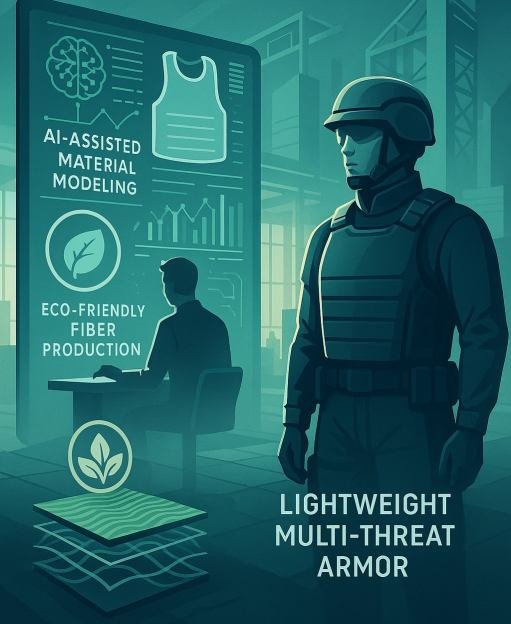
The next decade will see lighter, multi-threat armors integrating AI-assisted material modeling and eco-friendly fiber production.
Sustainability and performance are converging—ensuring soldiers and officers receive protection without added burden.
ArmorGuard continues to invest in research partnerships and advanced molding technologies to maintain its leadership in Asia’s ballistic protection manufacturing landscape.