An insight-driven report by ArmorGuard exploring the evolution of lightweight ballistic armor technologies, focusing on how manufacturers balance mobility, comfort, and safety in next-generation protection systems.
The Tactical Shift Toward Lightweight Armor
The modern battlefield demands both protection and mobility. Soldiers, law enforcement officers, and tactical units are facing multi-threat missions that require speed and agility as much as ballistic resistance.
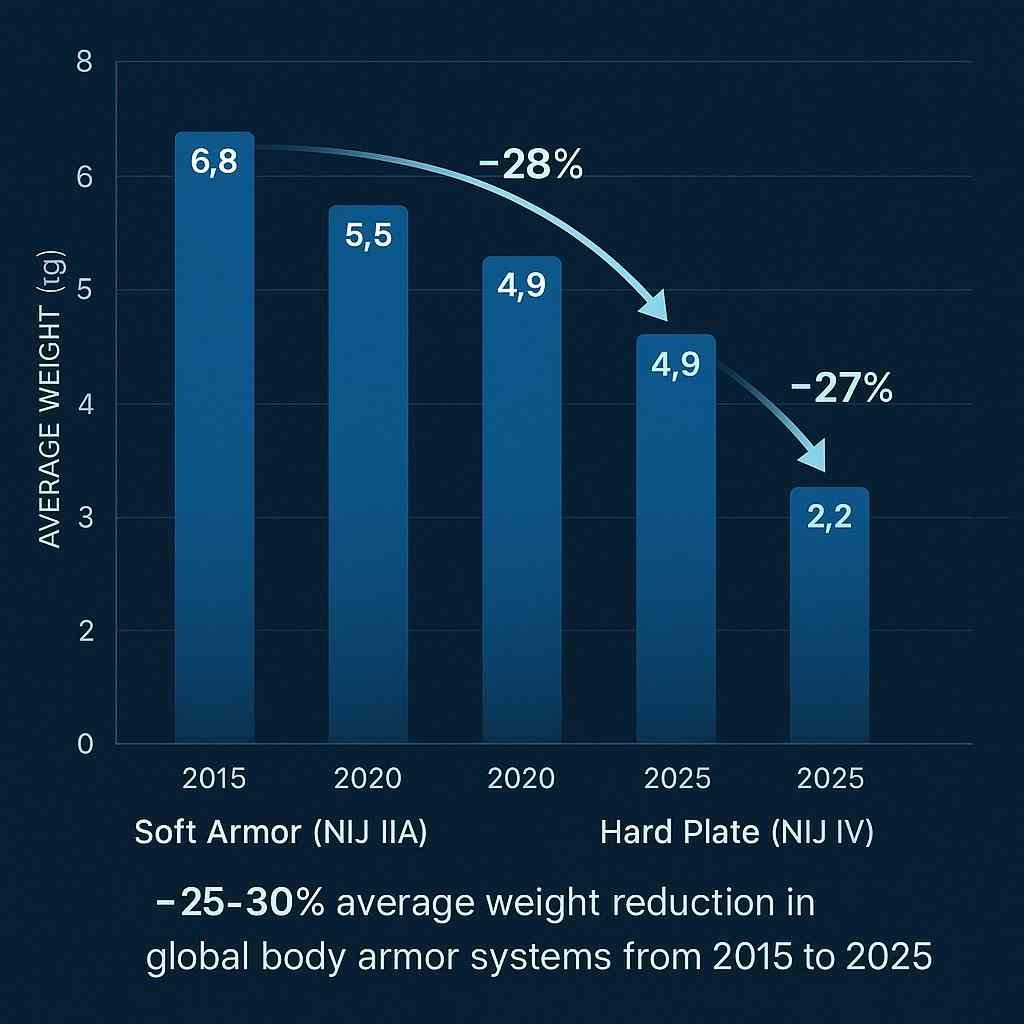
Over the past decade, global body armor systems have reduced average weight by approximately 25–30%, driven by the replacement of traditional steel and ceramic composites with Aramid, UHMWPE, and hybrid laminate systems.
For example, a typical NIJ Level IIIA soft armor vest that weighed around 6.5–7.0 kg in 2015 now averages 4.8–5.2 kg in 2025, while Level IV hard plates have dropped from 3.0 kg per plate to 2.1–2.4 kg through advanced molding and fiber optimization.
This transition not only enhances tactical mobility but also reduces long-term fatigue, thereby improving endurance and accuracy during prolonged deployments.
ArmorGuard engineers this evolution through its ballistic protection manufacturing ecosystem—integrating lightweight composites, ergonomic design, and mission-adapted configuration to deliver maximum protection with minimal load.
✅ Data Summary (2025 Industry Benchmark)
| Year | Armor Type | Average Weight (kg) | % Reduction (vs. 2015) | Material Evolution |
| 2015 | Soft Armor (NIJ IIIA) | 6.8 | — | Aramid dominant |
| 2020 | Soft Armor (NIJ IIIA) | 5.5 | ↓19% | Aramid + early UHMWPE |
| 2025 | Soft Armor (NIJ IIIA) | 4.9 | ↓28% | Hybrid composites |
| 2015 | Hard Plate (NIJ IV) | 3.0 | — | Ceramic + metal composite |
| 2020 | Hard Plate (NIJ IV) | 2.5 | ↓17% | Ceramic + UHMWPE backing |
| 2025 | Hard Plate (NIJ IV) | 2.2 | ↓27% | Fully hybrid composite |
Why Weight Reduction Matters in Modern Warfare
Weight is one of the most critical variables in soldier performance.
Excessive load directly affects mobility, fatigue, situational awareness, and mission endurance.
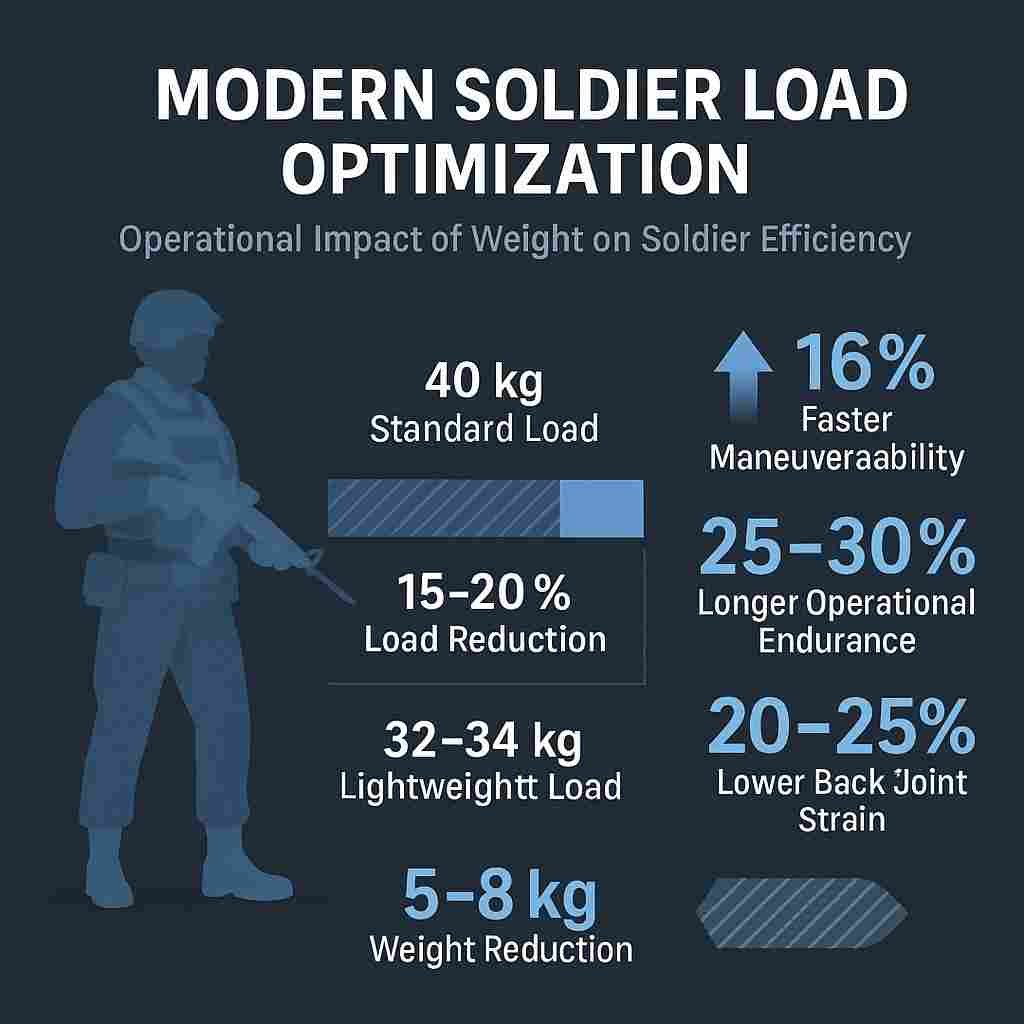
According to NATO Soldier Systems research and U.S. Army Natick studies, the average combat load for a modern infantry soldier ranges between 35–40 kg, including armor, weapon systems, ammunition, communication devices, and hydration.
The current global lightweight armor objective aims to reduce that burden by 15–20%, primarily through the introduction of hybrid ballistic composites, optimized carrier design, and modular load distribution.
⚙️ Operational Impact of Weight on Soldier Efficiency
| Parameter | Standard Load (40 kg) | Lightweight Load (32–34 kg, -15–20%) | Performance Impact |
| Mobility Speed (avg. over 1 km) | 4.8 km/h | 5.6 km/h | ↑ ~16% faster maneuverability |
| Combat Endurance (time to fatigue) | 100% baseline | 125–130% | ↑ +25–30% longer operational endurance |
| Shooting Accuracy (under exertion) | Baseline | +12–15% | Less weapon sway & fatigue effect |
| Energy Expenditure | 100% | 82–85% | ↓ 15–18% lower oxygen demand |
| Reaction / Response Time | Baseline | 10–12% faster | Faster movement under threat |
| Injury Risk (musculoskeletal) | High | Reduced | ↓ 20–25% lower back & joint strain risk |
These performance gains demonstrate that even a 5–8 kg weight reduction in armor and load-bearing equipment can dramatically enhance mission effectiveness — especially during long-distance patrols or high-mobility engagements.
ArmorGuard integrates these principles through its lightweight armor development program, utilizing hybrid materials (Aramid + UHMWPE) and ergonomic carrier geometry to maximize both protection and agility in modern warfare.
Technological Advances Driving Lightweight Armor
Recent innovations have fundamentally transformed ballistic protection manufacturing.
The convergence of material science, 3D engineering, and modular ergonomics has enabled the next generation of tactical armor—combining mobility, comfort, and certified ballistic performance.
Today, lightweight armor technologies account for more than 70% of all new ballistic product development, driven by the global demand for enhanced endurance, multi-threat protection, and rapid deployability.
⚙️ ArmorGuard Lightweight Technology Utilization (2025 Reference)
| Technology | Function / Advantage | Typical Weight Reduction | Global Industry Adoption | ArmorGuard Integration Ratio (2025) |
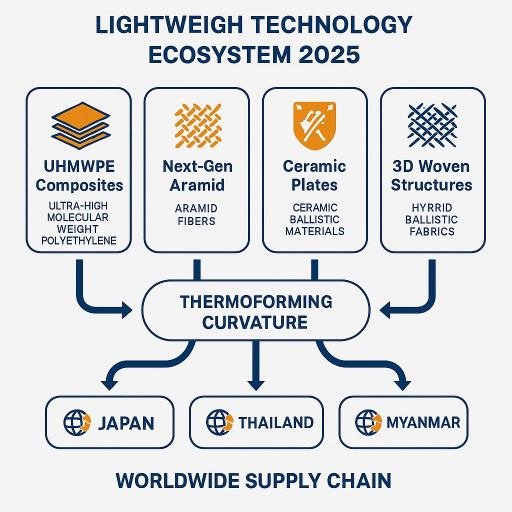
| UHMWPE Ballistic Composites | Ultra-light polymer fibers with exceptional impact resistance and flexibility | ↓25–35% vs Aramid | ~60% | ≈55% (core material for soft & hybrid armor) |
| Next-Gen Aramid (Kevlar®, Twaron®) | High-heat-resistant synthetic fibers for multi-hit stability and cost-efficient production | ↓10–15% vs legacy Aramid | ~40% | ≈25% (soft armor and hybrid reinforcement) |
| Ceramic-Composite Plates (SiC, B4C) | Rifle-level protection with reduced areal density, replacing traditional steel plates | ↓30–40% vs steel | ~35% | ≈15% (hard armor line) |
| 3D Woven Hybrid Structures | Directional fiber architecture improves trauma reduction and structural integrity | ↓15–20% per panel | ~20% | ≈5% (R&D / hybrid product range) |
| Thermoformed Curvature Technology | Heat-formed ergonomic shaping reduces stress points and improves comfort | — | ~50% | ≈90% (standard in all tactical vest carriers) |
⚙️ ArmorGuard Lightweight Material Supply Chain (2025 Overview)
| Source Region | Core Material Type | Supplier / Function | Application in Production |
| Japan / Netherlands | UHMWPE & High-Grade Aramid | DSM Dyneema®, Teijin Twaron® | Core ballistic fabric and UD composite supply |
| Thailand | Lamination & Forming | ArmorGuard R&D Center | Hybrid panel fabrication and thermoforming |
| Myanmar | Assembly & QC Inspection | ArmorGuard Manufacturing Base | Tactical vest production, quality traceability |
| China (Support) | Accessories & Coatings | YKK®, IRR & Waterproof Fabric Vendors | MOLLE webbing, trims, IRR-treated fabrics |
| Europe (Partnerships) | Ceramic Plate Systems | CoorsTek, Saint-Gobain | Rifle-rated plate integration for NIJ Level IV |
Balancing Mobility and Safety: The Engineering Challenge
Reducing weight without compromising safety requires advanced engineering. Every gram removed must be compensated with structural integrity, material density optimization, and precise ballistic testing. This balance is achieved through computer modeling, finite element analysis, and iterative prototype testing under ballistic testing and certification .
ArmorGuard’s engineers model how energy waves travel through layered materials to ensure kinetic absorption meets NIJ standards while maximizing flexibility and operator range of motion.
Hybrid and Modular Armor Systems
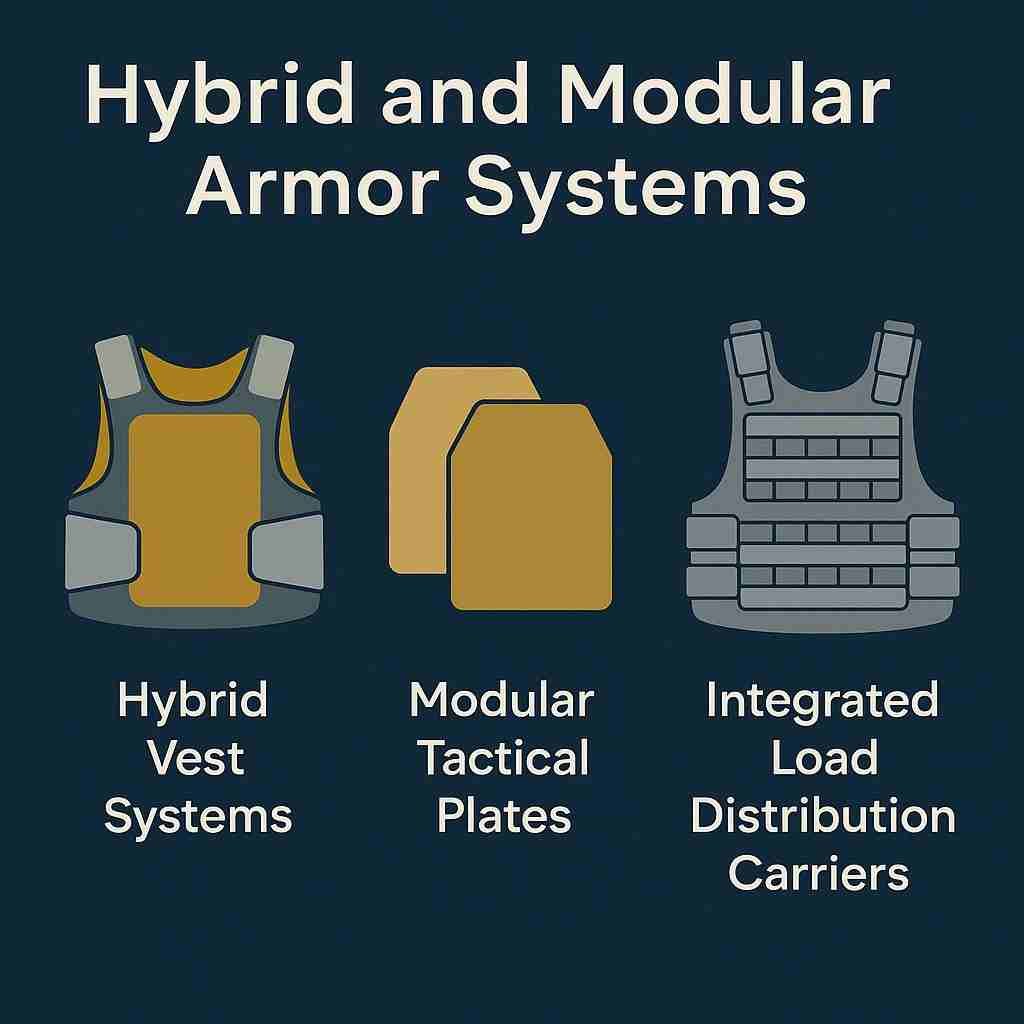
To demonstrate how lightweight performance is achieved in real-world scenarios, ArmorGuard has implemented hybrid and modular armor systems across multiple OEM projects.
• Hybrid Vest Systems: Combining 60% Aramid and 40% UHMWPE for optimal balance between heat resistance and mobility.
• Modular Tactical Plates: Designed for quick replacement and field repair without compromising protection integrity.
• Integrated Load Distribution Carriers: Reduce spinal load by redistributing weight through adjustable suspension harnesses.
Each configuration undergoes validation within ArmorGuard’s OEM workflow (see Inside a Ballistic Vest OEM Project and is certified according to NIJ and STANAG standards.
The Future Outlook: Integrating Smart Fabrics and AI Testing
The next decade of lightweight armor will integrate smart textiles, adaptive composites, and AI-driven ballistic testing. Embedded sensors may soon monitor impact stress, temperature, and wear conditions in real time, allowing predictive maintenance and certification renewal.
Artificial intelligence will enhance ballistic validation by simulating thousands of impact conditions, reducing testing time and material waste. ArmorGuard is actively exploring digital twin models and machine learning algorithms to accelerate future armor design within its OEM & ODM solutions.