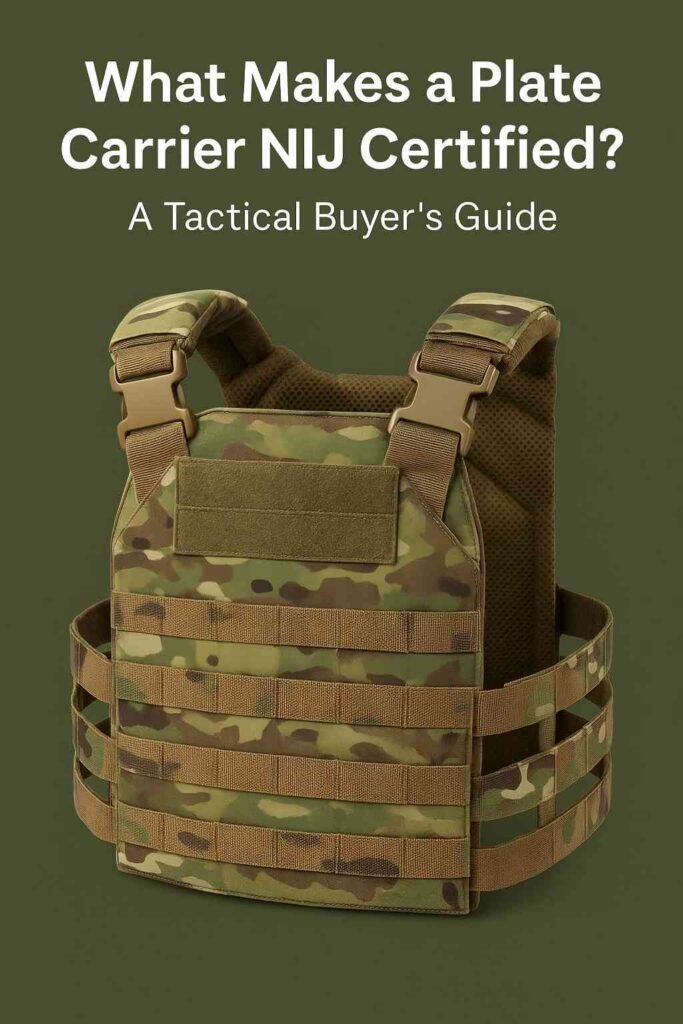
Introduction: What Does “NIJ Certified” Actually Mean?
For tactical gear buyers, few labels carry more weight than “NIJ certified.” But what does that term truly mean—and how can you tell if a plate carrier lives up to the standard?
In procurement tenders and high-risk field operations, NIJ certification isn’t just a feature—it’s often a requirement. Understanding how this certification works and how to evaluate a plate carrier for real-world readiness is essential for any defense, law enforcement, or private security buyer.
NIJ Levels Explained: Matching Certification to Mission Risk
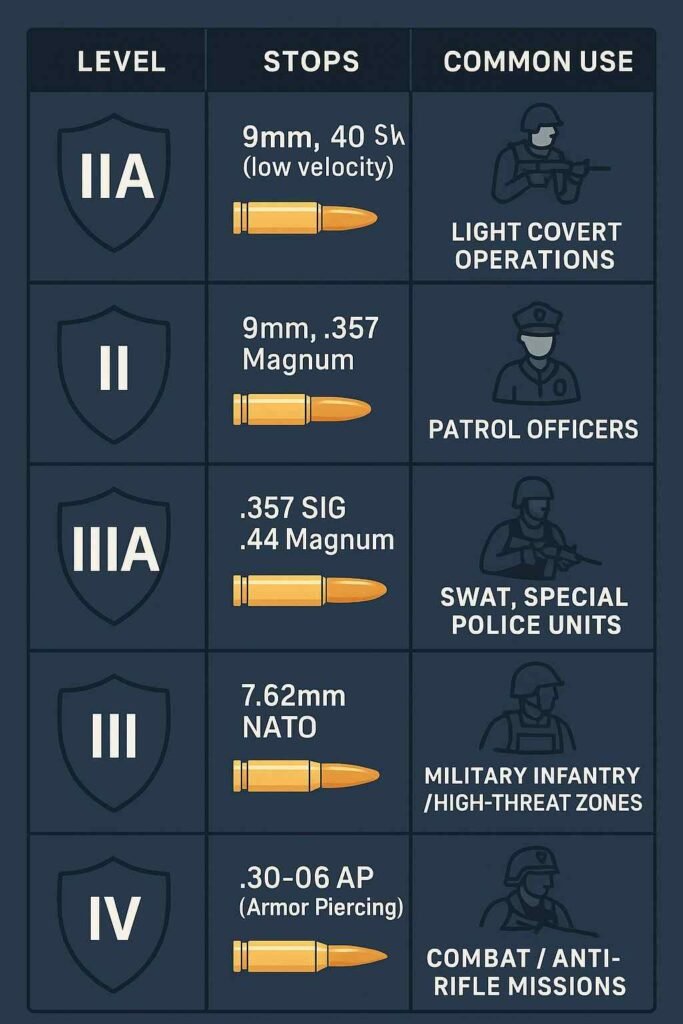
The National Institute of Justice (NIJ) in the U.S. defines ballistic protection standards used worldwide. Each level represents a specific capability to stop certain ammunition threats. Here’s a breakdown:
| Level | Stops | Common Use |
| IIA | 9mm, .40 S&W (low velocity) | Light covert operations |
| II | 9mm, .357 Magnum | Patrol officers |
| IIIA | .357 SIG, .44 Magnum | SWAT, special police units |
| III | 7.62mm NATO | Military infantry / high-threat zones |
| IV | .30-06 AP (Armor Piercing) | Combat / anti-rifle missions |
Tactical Insight: For law enforcement, Level IIIA is the most common for soft armor vests. For military and high-risk contractors, Level III or IV rigid plates integrated into carriers are standard.
How to Evaluate a Plate Carrier for NIJ Compliance
A common misconception: the carrier itself is certified. In reality:
- NIJ certifies the ballistic system (plate + carrier) as a whole
- The plate is what provides ballistic protection, not the fabric shell
- The carrier must be compatible with certified plates (fit, stability, coverage)
When evaluating a carrier:
- Check for Compatibility
- Inspect for Closure & Retention
- Review Supporting Documentation
✅ Want a full OEM breakdown on armor system evaluation? Please read our guide to NIJ-certified plate carriers for full-system procurement insight.
What Makes a Plate Carrier Truly Field-Ready?
Beyond certification, tactical carriers must perform in the field:
- Ergonomics & Weight Distribution: Adjustable shoulder straps, load-bearing belts, and quick-release buckles help reduce fatigue during long missions.
- Material Performance: The use of Cordura® 500D/1000D with IRR treatment ensures durability and low visibility under night vision conditions. Are you unsure which material suits your career? Learn the trade-offs between 500D and 1000D Cordura® materials.
- Ventilation & Heat Dispersion: Mesh linings, spacer foam, and 3D padding help manage heat in tropical or urban environments.
- Modularity: PALS/MOLLE webbing allows for mission-specific pouches and attachments.
Pro Tip: A “certified” plate with a poor-fit or low-grade carrier can still fail in the field. Certification ≠ of operational readiness.
Standard Buyer Mistakes in NIJ Plate Carrier Selection
Even experienced procurement teams make avoidable errors. Here are the top pitfalls:
- Assuming the vest itself is ballistic: Many tactical vests are load-bearing only unless fitted with armor inserts.
- Confusing “NIJ tested” with “NIJ certified”: Anyone can claim “tested”; only NIJ-approved labs can certify.
- Over-purchasing (Level IV when Level IIIA would suffice): Heavier plates reduce mobility and increase fatigue unnecessarily.
- Missing documentation during tenders: Lack of official test reports can lead to bid disqualification.
Checklist Before Purchase:
- Confirm plate level & lab certification
- Ensure carrier compatibility
- Ask for test reports, drawings, and COAs
- Consider mission needs, not just max protection
See our tactical gear certification checklist to avoid common errors in tenders.
How to Work with OEM Manufacturers for Certified Plate Carriers
If you’re procuring for a unit, agency, or tender, working with an OEM saves time and reduces compliance risk. Here’s how:
- Start with Mission Requirements
- Use Supplier’s NIJ-Ready Platforms
- Request Prototyping & Test Fit
- Negotiate Documentation Packages
For a deeper look at OEM tactical plate carrier development workflows, check our comparative manufacturing guide.
What ArmorGuard Offers for Certified Tactical Systems
At ArmorGuard, we integrate NIJ-certified plates with modular, field-tested plate carriers built for operational use. Our OEM clients benefit from:
- IRR-compliant Cordura® with YKK/UTX hardware
- Custom sizing and pouch layout
- Quick prototyping (7–10 days)
- MOQ flexibility for testing and phased deployments
- Tender-ready export documentation
Note: While ArmorGuard does not self-certify plates, we source from NIJ-certified vendors and offer plate + carrier compatibility testing as part of our OEM service.
Final Considerations for Tactical Gear Buyers
Selecting a plate carrier is more than a product decision—it’s a risk management step.
- Certified protection = Bid eligibility
- Proper fit = Operational safety
- OEM integration = Reduced project complexity
And when in doubt: always ask for documentation. Any serious supplier will have it ready. Looking to learn more about choosing the right manufacturing partner for your tactical gear program? Start with our comprehensive guide to OEM tactical gear manufacturers.